


Many people have discussed the fact that many algorithmic innovations are scale-dependent. This means that they have small (or negative) benefits at small compute scales, and their benefit grows as training compute increases.
Here’s an example with made-up numbers: Mixture of Experts might only be a 1.1x efficiency improvement over dense models at training runs of 1e20 FLOP, but a 4x improvement at runs of 1e25 FLOP.
In this post I assess whether scale-dependent algorithms cut against there being a software-only intelligence explosion (SIE).
My bottom line is:
Yes, scale-dependent algorithms cut against an SIE.
The amount they do so depends on exactly how you measure algorithmic progress.
Given how I guess AI companies actually measure algorithmic progress, the effect is small. This is likely not a significant drag on the SIE.
AI companies should publish data that I describe in this post, so we can assess whether there will be an SIE.
Warning: all the specific numbers I use in the post are made-up for illustrative effect.
Scale-dependent algorithms cut against an SIE
Some have suggested that, when we learn that much algorithmic progress is scale-dependent, we should update against there being a software intelligence explosion (SIE).
Here’s the argument. (If you’re impatient, skip to the second diagram.)
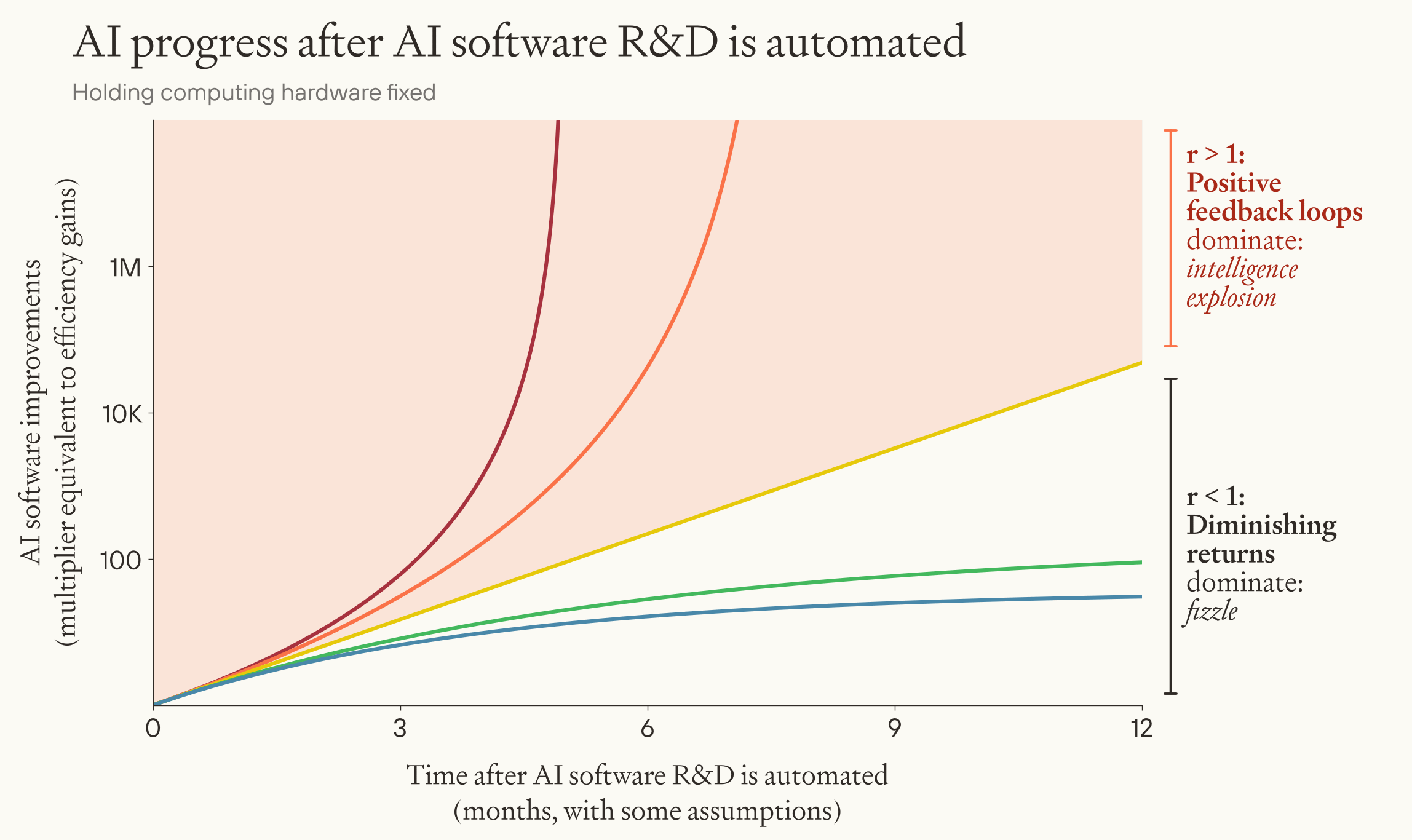
In many models of the intelligence explosion, whether there is an SIE depends on whether a particular parameter, r, is sufficiently high.1 r captures how steep the diminishing returns are to improving algorithms.
And a common way to estimate r is as follows:
r = (growth rate of algorithmic efficiency) / (growth rate in inputs to AI R&D)
If this estimate shows that r is sufficiently high, the model predicts an intelligence explosion.
How could scale-dependent algorithms undercut this conclusion?
By inflating our estimate of the numerator: growth rate of algorithmic efficiency.
Let’s continue with our earlier made-up numbers.
Suppose we discover MoE in 2020 when training runs were 1e22 FLOP. Then we scale up training runs to 1e25 FLOP. We then calculate that the efficiency gain from MoE is large (4x!), and plug this into our overall estimate for the growth rate of algorithmic efficiency. We find that r is above the threshold for an intelligence explosion!
But, the objection goes, we’ve made a critical mistake.
In our estimate, we scaled up training compute by 1000x after we discovered MoE. This massively increased how good it was. But during an SIE, we won’t be able to scale up training compute anything like that much. Compute will be roughly constant. (More precisely, it will grow very slowly compared to algorithmic progress.)
To accurately simulate the conditions of an SIE, we’d be better off holding training compute fixed after MoE is discovered. In which case, the efficiency gain from MoE is much smaller (1.1x). We’ll get a lower estimate for the growth rate of algorithmic efficiency. And so r is more likely to be below the threshold for an intelligence explosion.
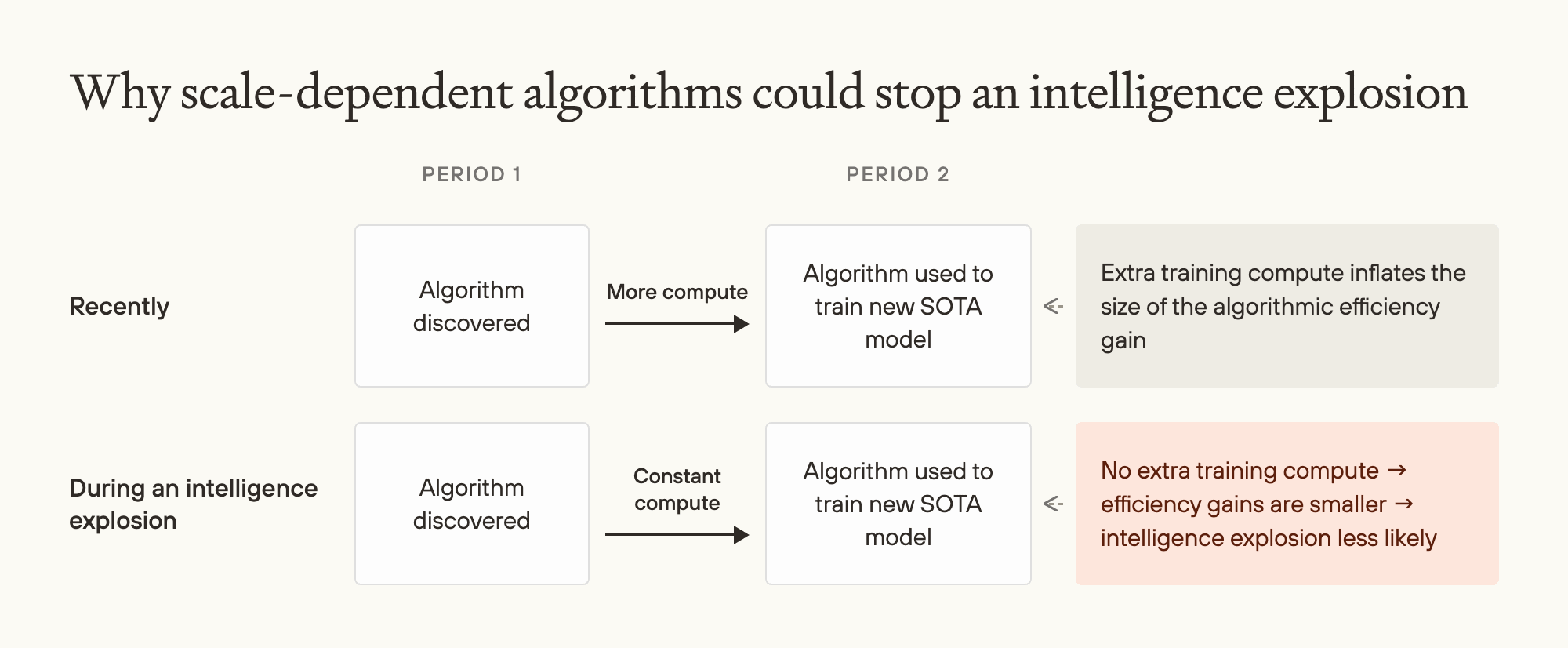
So: naive estimates of r shouldn’t be plugged into estimates of whether there will be an SIE. They should be adjusted downwards somewhat.
But by how much?
I think this depends on the details of 1) exactly how AI companies are estimating algorithmic progress, and 2) how much this estimate would change if the company hadn’t been increasing training compute. Let me walk through some examples.
Exactly how much do scale-dependent algorithms cut against an SIE? Probably not that much.
Let’s say that in 2025 an AI company trains a SOTA model with 1e25 FLOP. They train it with their best 2025 algorithms.
Then, in 2026, that same company trains a new SOTA model with 3e25 FLOP. They train it with new and improved 2026 algorithms.
Here’s a very natural way for the AI company to calculate the algorithmic efficiency gain.
Look at the performance of the 2026 model.
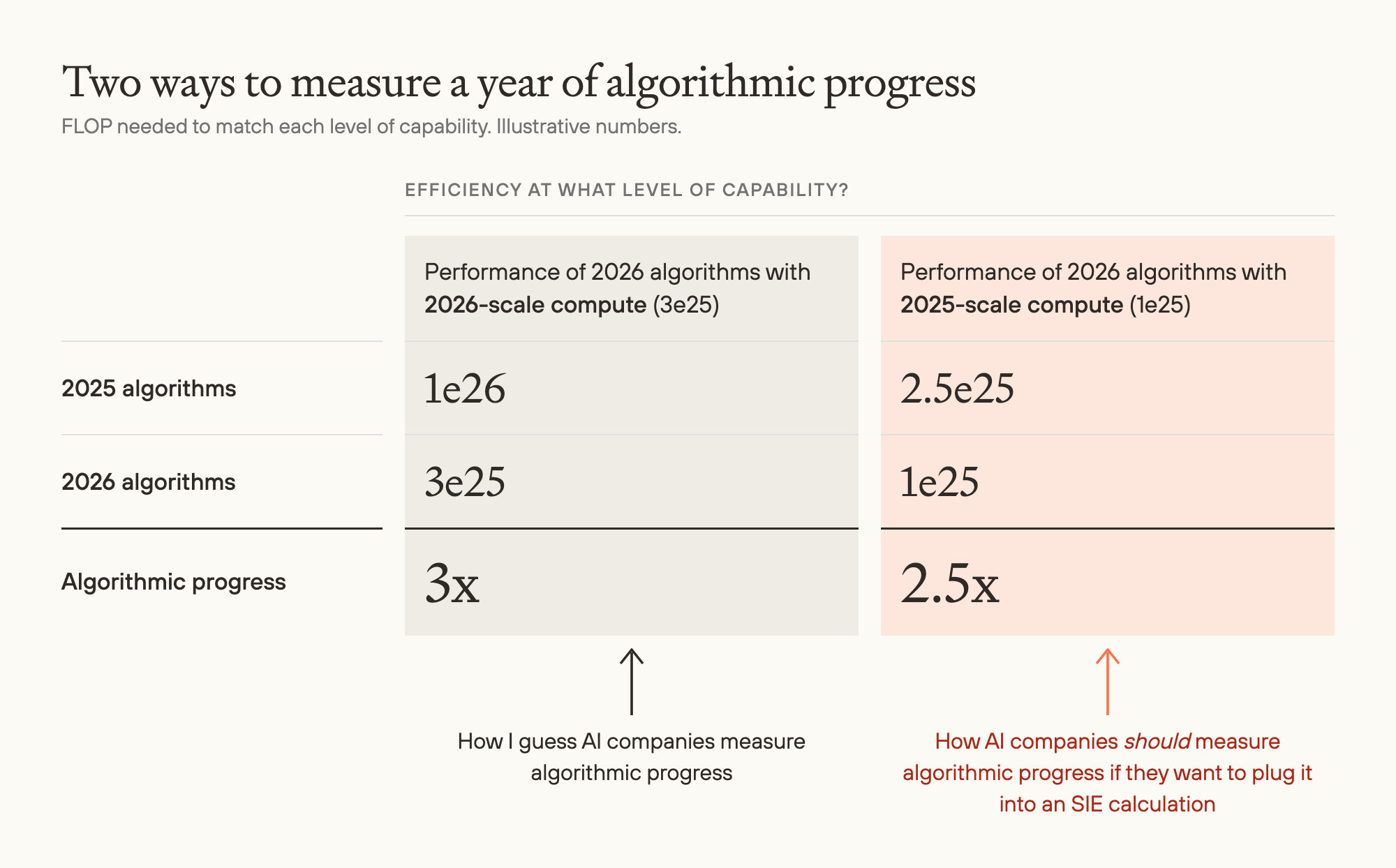
Look at the scaling curve for the 2025 algorithms. Calculate how much FLOP would be needed to match the 2026 model with the 2025 algorithms. Eg “1e26 FLOP”.
Calculate the efficiency gain: how much less FLOP the 2026 algorithms used than the 2025 algorithms would have needed. Eg 1e26 / 3e25 = ~3x
When I hear rumours of “10x/year efficiency gains” my guess is that this is how they’re calculated.2
So why is this biased?
As discussed above, it’s biased because during an SIE, compute remains ~fixed after discovering a new algorithm. If a new algorithm is discovered, it cannot be trained on more compute than previous algorithms. Only the same amount.
So if we’re calculating the efficiency gains from new algorithms, and we want to plug this into an estimate of whether there will be an SIE, we should hold training compute constant.
To adjust for this, the AI company should do a different calculation:
Look at the performance of the 2026 algorithms when trained with 2025-scale compute. Call this the performance of the downscaled 2026 model.
Look at the scaling curve for the 2025 algorithms. Calculate how much FLOP would be needed to match the performance of the downscaled 2026 model. Eg “2.5e25 FLOP”.
Calculate the efficiency gain: how much less FLOP the 2026 algorithms used than the 2025 algorithms would have needed.
For example, the 2026 algorithms used 2025-scale compute, which in our example is 1e25 FLOP. The 2025 algorithms would have needed 2.5e25 FLOP to get that performance. Efficiency gain = 2.5e25 / 1e25 = 2.5x
The new efficiency multiplier will likely be smaller precisely because of scale-dependent algorithms. If the 2026 algorithms are scale-dependent, they’ll have bigger benefits at 3e25 FLOP than at 1e25 FLOP.
This logic is summarised in the following table:
So, how big is the downwards adjustment likely to be?
My guess is that the difference isn’t that big.
Year on year, the scale of training compute is not increasing by that much.
While it’s plausible that the gains from MoE go from 1.1x to 4x when you increase training FLOP by 1000x, we likely see smaller jumps when increasing training FLOP by just 3x.
It all depends on how the AI company measures its algorithmic progress
I want to emphasise how much the size of the bias depends on the methodology used by the AI company.
Here’s another methodology that AI companies could hypothetically follow (I think it’s very unlikely they follow it):
Look at the performance of the 2026 model.
Look at the scaling curve for the 2020 algorithms. Calculate how much FLOP would be needed to match the 2026 model with the 2020 algorithms. Eg “1e32 FLOP”.
Calculate the efficiency gain: how much less FLOP the 2026 algorithms used than the 2020 algorithms would have needed. Eg 1e32 / 3e25 = ~3,000,000x
Here the AI company anchors to their 2020 algorithms in making the estimate. This means that all scale-dependent algorithmic advances since 2020 are amplified all the way up to the 2026 compute scale. They estimate a huge algorithmic advance from a single scale-dependent breakthrough.
This leads to a much bigger bias. To correct for this bias, we’d need to calculate the efficiency gain on 2020-scale compute. That would likely be much much smaller, e.g. 3x.
The critical question is how frequently does the AI company recalculate its algorithmic progress multiplier. If it’s every year (as in the first example) the bias is small. If it’s every 6 years (as in the second), the bias is big.
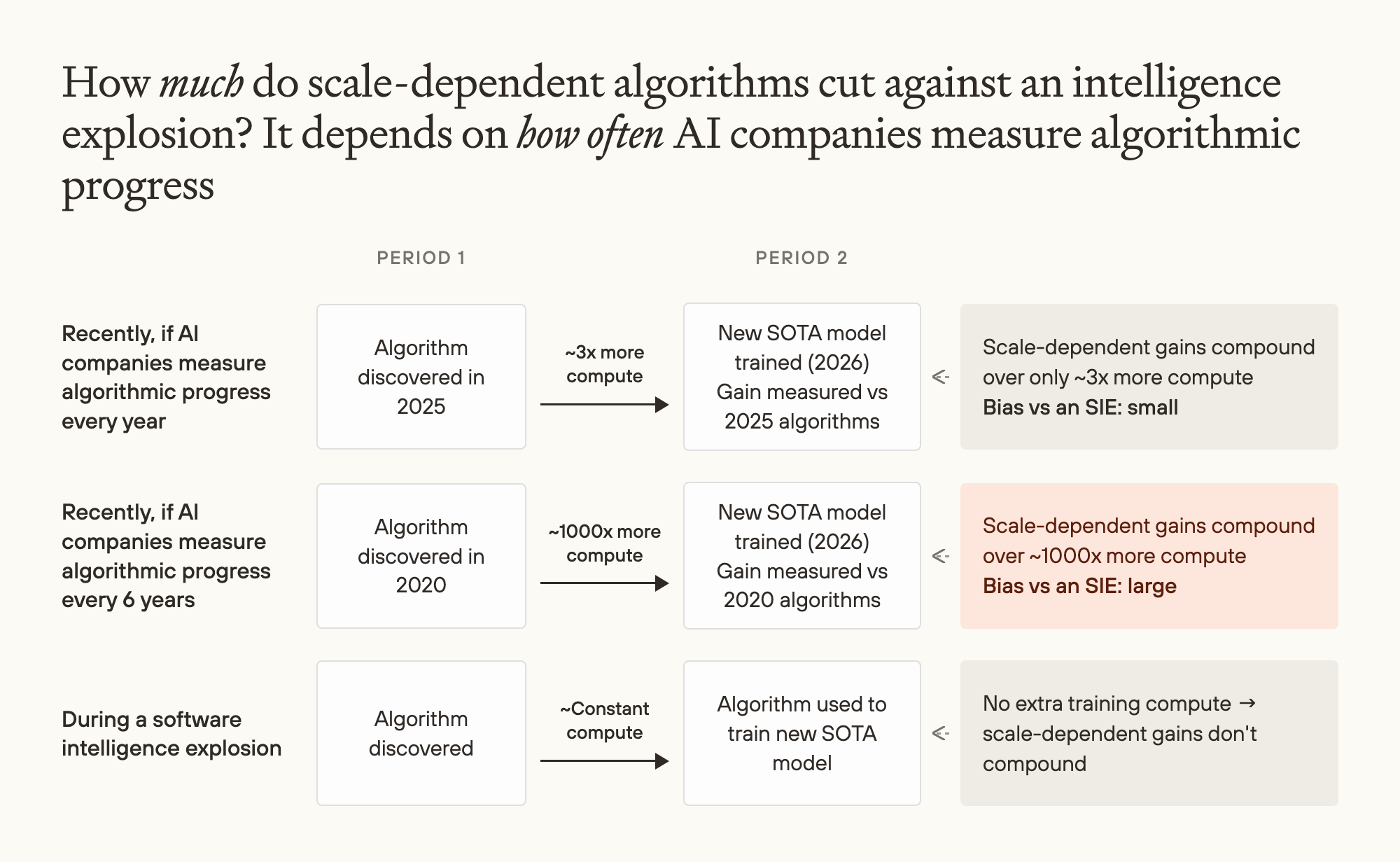
Given the methodology that I guess AI companies are using, where they calculate algorithmic progress at regular intervals, the downwards adjustment is small.
In fact, given the blistering pace of model releases, I’d guess that AI companies are recalculating their algorithmic progress every few months. This will further decrease the size of the bias.
I actually adjust for something very much like this bias in my previous work.3 I included a haircut to r of 0.5x, which I actually now think was likely too big a haircut. So thinking this through has updated me upwards on whether there will be an intelligence explosion.
Another bias to the SIE estimate: inaccessible algorithms
So far, I’ve discussed one particular bias: that companies likely anchor to the new scale of compute when assessing new algorithms. To avoid this bias, they can anchor to the old scale of compute, as I proposed above.
But there’s a further bias.
If compute stayed constant, then many of the scale-dependent algorithms just wouldn’t have been useful at all. For example, if compute scales had remained at 2020 levels, MoE would have harmed performance, not helped. This does mean that many algorithmic advances simply wouldn’t have been accessible.
To try and correct for this bias, an AI company could try to calculate how much algorithmic progress would have happened if compute had stayed at 2020 levels. They could use the following methodology:
Look at the compute used to train the SOTA model in 2020. This is 2020-scale compute. Eg 1e20.
Train the best performing model they can using 2026 algorithms and 2020-scale compute. Look at its performance.
Look at how much more compute would be needed to match that performance by 2020 algorithms. Eg 1e22.
Calculate the efficiency multiplier. Eg 1e22/1e20 = 100x
This estimate is more informative if you’re forecasting large software intelligence explosions, with >6 years of algorithmic progress happening in one year.
Evidence from Gundlach et al and Dwarkesh suggests the pace of progress is maybe ~50% lower at very small scales (~1e19 FLOP training runs).4 That suggests this is a notable downwards adjustment, but not a massive one.
AI companies can and should do this experiment. It wouldn’t be costly, and it would be very informative.
But I do think that interpreting this result naively would underestimate the potential for an SIE.
AI companies have been actively looking for scale-dependent algorithms because they’ve been increasing their training compute. An algorithm that scales well is a gold mine! All the effort has gone into finding them.
During an SIE, the incentives shift. No one cares about whether algorithms improve with compute. They just care about whether they work well with the current levels of compute. So we’ll find fewer scale-dependent algorithms and more algorithms that just work well with existing compute.
In other words: we haven’t been trying to find algorithms that work well at 2020 levels of compute. So it’s unsurprising if the above experiment suggests that we haven’t made much progress on it.
Conclusion
Having thought more carefully about how AI companies are likely to measure algorithmic progress, I don’t think scale-dependent algorithms mean that they’re significantly overestimating the pace of algorithmic progress. They likely measure it regularly, and so the benefit of scale-dependent algorithms is only measured over a small increase of scale. This is likely a small downwards adjustment on an estimate for r, the parameter determining whether there will be an SIE.
That said, a big additional uncertainty is the importance of inaccessible algorithms.
AI companies should publish their estimates of algorithmic progress, including the adjusted estimates I’ve suggested, so the public can understand this critical question.
I’m more confused on how to think about inaccessible algorithms. This could potentially be a big downwards adjustment, if an SIE hopes to make >5 years of algorithmic progress. On the other hand, maybe companies have seen similar algorithmic progress even at much lower compute scales, or maybe they would have done if they’d been trying.
Appendix: doesn’t Epoch’s “8 month doubling time” methodology have a bigger bias though?
Firstly, I am much more interested in the AI company's measurements of algorithmic progress than Epoch's old estimate. I think it may still be the best public estimate we have, but it is incredibly noisy.
Secondly, no, I don't think it's clear that Epoch's methodology has a big bias. They do not do the thing I warned against, where you look at the 2020 scaling law and then look at the algorithmic improvements on top of that using 2026 compute. They do regression of performance from inputs of time (as a proxy for algorithms) and of compute. Gundlach claims that this regression will credit ‘better algorithms’ with the gains from scale-dependent algorithms. But it's equally possible that the regression credits ‘more compute’. Scale-dependent algorithms depend on both algorithmic progress and more compute, and so it's unclear which input the regression would credit.
This article was created by Forethought. See all our research on our website.
In simple models, there’s an SIE just if r > 1. (Though you want to adjust r downwards to account for compute bottlenecks.) In better and more recent models, you multiply r by a few other quantities, and the result must be greater than 1. In all models, r plays a critical role.
I literally mean “a guess”. I don’t know.
Search for “Downwards for fixed scale of hardware”.
Measured in orders of magnitude (OOMs) of efficiency gain per year. Dwarkesh Patel and Jerry Han train 2019–2025 public recipes and datasets at up to 1e19 FLOP and find combined algorithm + data efficiency gains of ~1.57x/year (~0.2 OOMs/year), vs. Ho et al.'s frontier estimate of ~3x/year (~0.48 OOMs/year), i.e. ~40% of the frontier rate. Gundlach et al. can account for <100x of efficiency gains over 2012–2023 using small-scale experiments plus literature estimates (~0.18 OOMs/year), vs. the ~22,000x (~0.39 OOMs/year) previously estimated for that period, i.e. ~45% of the rate. These are lower bounds on small-scale progress in some respects: they use public rather than frontier-lab recipes, exclude some innovations (e.g. tokenizers, inference optimizations), and use relatively easy benchmarks. And 1e19 FLOP is ~4 OOMs below even 2020 frontier training runs, so the gap at near-frontier scales is likely smaller.