


This article was created by Forethought. See all our research on our website.
Main Takeaways
Launch costs have fallen by roughly an order of magnitude, driven disproportionately by the rise of reusable US rockets. In both 2024 and 2025, the United States accounted for more than 84% of global launch mass, and if Starship matures its share could exceed 99% for some multiyear window.1 At the same time, the United States is also developing space-based interceptors for missile defense through Golden Dome, with an initial capability demonstration targeted for 2028.

But what is underappreciated is that space-based interceptors would be useful for much more than missile defense. They could attack and defend satellites, prevent rivals from establishing a useful presence in orbit, and contest transit beyond Earth. The first state to field a layered orbital force might therefore be able to lock others out of space, with large military consequences both in space and on Earth.2
This post asks whether the United States could convert its launch lead into this kind of space superiority, and whether the same weapons could ultimately break nuclear deterrence. I argue that:
The United States can probably convert its launch lead into launch denial and broader space superiority if it chooses to. Simple models of orbital coverage suggest that denying rivals useful operation in space might require roughly two dozen platforms in medium Earth orbit (MEO), while denying launch globally might require an additional 310–880 interceptors in low Earth orbit (LEO). A first generation of this architecture could cost on the order of $4–14 billion. Rival countermeasures create substantial uncertainty but do not clearly eliminate the launch-leader’s advantage. If this is right, the United States could protect its own orbital infrastructure while denying rivals access to orbital infrastructure and controlling the principal route from Earth to the rest of the Solar System.
Breaking near-peer nuclear deterrence is much harder, but AI-enabled automation might make it possible. Comprehensive defense against a near-peer arsenal might require roughly 74,000–458,000 interceptors, cost $0.7–4.6 trillion, and take four to eight years to produce. On conventional industrial timescales, the shield would erode deterrence as it grew but leave rivals time to expand or redesign their arsenals, negotiate limits, or threaten war before it became decisive. Starship might compress the final deployment into weeks or months, but a launch lead alone would not eliminate this long production buildup. If advanced automation drives an Industrial Explosion in which the United States can scale production much faster than its rivals could respond, nuclear breakout may be possible and could occur amid the wider disruption or simultaneous crises an Industrial Explosion would produce.
This post contains three sections:
Space weapons. I describe the state of missile defenses today and how space weapons could change this in the near future.
Launch denial. I evaluate whether the US could use space weapons to prevent others from launching space assets.
Nuclear deterrence. I evaluate whether the US could use space weapons to erode the nuclear deterrence of other nations.
Space Weapons
The first state to deploy weapons in space at scale may be able to shut others out of orbit and to blunt their nuclear forces. To see how, I’ll first cover why the missile defenses fielded today can’t protect a state against a peer arsenal, then why falling launch costs and better automation are turning orbit into an affordable place to put weapons, and what orbit offers strategically that positions on Earth cannot. The short version is that defenses on Earth have to engage a missile late in its flight, once it has released its warheads among decoys, whereas a weapon in orbit can strike early during the few minutes of ascent, when a rocket is vulnerable and unable to deploy decoys. I’ll close by looking at the program now building toward this, the United States’ Golden Dome, and the several distinct military capabilities that orbital weapons would confer at once.
Current missile defense is regional only, and has to contend with decoys, making it harder to scale up. Today, the United States and its allies field layered ground- and sea-based systems for missile defense (including Aegis, Ground-based Midcourse Defense, THAAD, F-35s equipped with air-to-air missiles, and Patriot3) while Russia retains a limited strategic defense around Moscow and China has repeatedly tested land-based midcourse interception. These protect particular theaters and particular targets, but scaling them to make a state secure against a full-scale peer nuclear assault is prohibitively costly. Ground-based missile defense must also engage an incoming missile in the difficult midcourse or terminal phase, after it has finished its climb and released its warheads along with cheap decoys such as balloons and chaff. A single missile can release multiple warheads alongside dozens of decoys. The defender must therefore either solve a hard discrimination problem to distinguish the decoys in the minutes available or fire an interceptor at every object, which means trading missiles that cost millions of dollars against decoys that cost almost nothing. But the cost economics of defense could be altered substantially by going to space.
One potent advantage that a nation could seize over the next few years would be placing space-based weapons in Earth orbit. The basic near-term weapon of this type would be the space-based interceptor (SBI).4 It is a guided missile which calculates an intercept course to a craft or missile and destroys it via high-speed collision. SBIs appear technically feasible in the near term because they largely combine mature technologies (i.e. exo-atmospheric interceptors with satellite buses capable of housing, powering, pointing, and deploying them). These weapons could engage intercontinental ballistic missiles (ICBMs) and submarine-launched ballistic missiles (SLBMs)5, potentially eroding nuclear deterrence as well as allowing for attack and defense in orbital warfare.
Further, a space-based interceptor would preempt decoys and evasion by striking targets early on, during their ascent6, giving it a major advantage over ground-based missile defense while also making global coverage feasible. During the few minutes a rocket7 is under power it is a single large object, burning brightly and unable to hide or maneuver, so destroying it kills every warhead and decoy aboard, and one interceptor can hence do the work that dozens would have to do later.8 A key advantage of going to orbit is that it allows an actor to stage military infrastructure directly over the head of an adversary with minimal time to target, including deep inside national borders and without need for foreign basing. In general it’s possible both to stage an SBI that regularly passes within a few hundred kilometers of any particular point on the Earth and to stage a sufficient number such that a region of the globe or the entire globe can always have one or more such satellites overhead (as is mostly the case with Starlink communications satellites today).9
Falling launch costs have already made fielding orbital weapons affordable, and the cost looks likely to fall further. Over the last decade, launch costs have fallen by about an order of magnitude, and it seems likely that the completion of Starship could further decrease the cost of launch by 1–2 orders of magnitude.
Currently the US is the sole nation with this kind of space-based defense system under development. Golden Dome, initiated by executive order in 2025, is a layered missile-defense program built around a space-based interceptor layer and sensing constellation.10 The US has various sensing capabilities deployed in space and has been proliferating a new mega-constellation in low orbit, with more than 150 Starshield military satellites staged so far by SpaceX.11 Contracts for prototypes of the space-based interceptor itself were awarded separately in 2026 with a goal of demonstrating interceptors by 2028.12 A recent Congressional Budget Office reference architecture uses roughly 7,800 space-based interceptors to engage ten nearly simultaneous ICBMs. At this scale Golden Dome would not offer defense against a near-peer like Russia (with deployable ICBMs in the hundreds) but could defend against rogue state nuclear arsenals.

In addition to missile defense, SBIs could potentially enable several other potent strategic capabilities on Earth and in space.
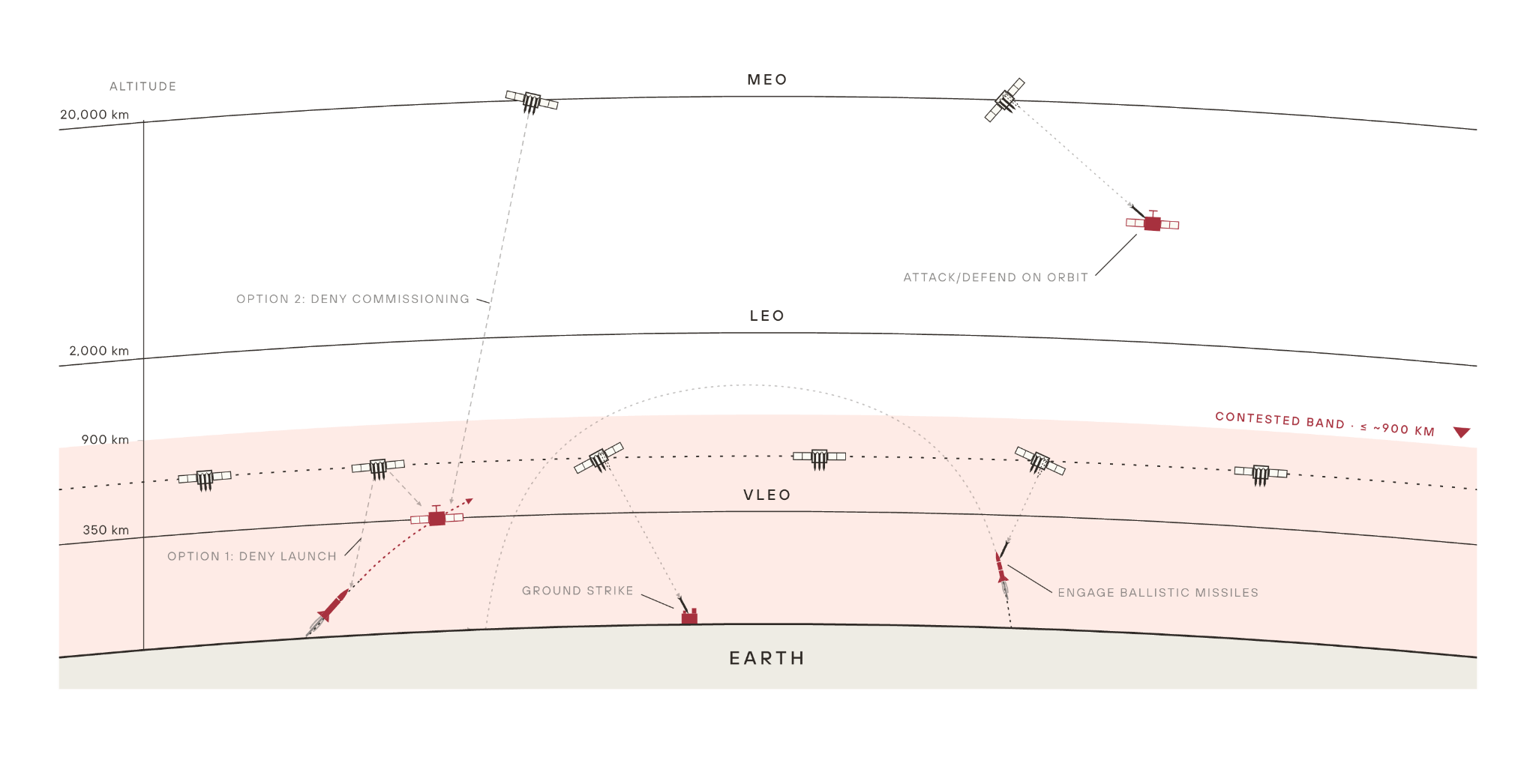
Deny operation in space. Blocking the rocket during its few minutes of boost requires an interceptor already nearby, so denying launch globally takes a screen of a few hundred platforms in low orbit. A weaker but far cheaper capability relaxes the timing: a payload that survives ascent must still commission and maneuver in a known orbit over hours or days, so denying rivals any useful presence in space (what I’ll call space-domain denial) might be managed by just a handful of higher platforms.
Attack and defend on orbit. SBIs could also double as space-to-space weapons for orbital warfare, striking rival satellites or hunting down craft headed beyond Earth orbit. In addition these platforms could defend themselves and other orbital assets by engaging direct-ascent anti-satellite weapons and rival co-orbital weapons.
Strike ground targets. Alternatively, missiles with reentry capability and explosive payloads can in principle also be placed in orbit to enable rapid ground strike on Earth. This ground strike variant could attack ground-based counterspace weapons, launch infrastructure, and other conventional military targets.13
The rest of this piece will assess whether the space-based weapons discussed above could enable the US to 1) deny launch to other nations, and 2) undermine other nations’ nuclear deterrence.
Launch Denial
In this section I’ll argue that the United States will likely have the ability to deny launch to other states, should it choose to use it. The basic reason is that the US is on track to operate the overwhelming majority of what goes up into orbit over the next several years. A rival that wants to contest this has to reach launch-parity or create novel ground-based anti-satellite weapons in order to do so.
I’ll first explain the strategic importance of launch denial and what it could mean if one state held this power. I’ll then work through the counter-strategies available to other nations and the launch-leader’s response to each, touching on whether a rival would escalate to war on Earth rather than fight in space (a question I take up properly in the next section). Finally I’ll set out what the system would cost and forecast how far away it is.
In short: control of orbit confers both military advantage on Earth and control of the only route to the rest of the Solar System; a first-generation system may cost on the order of $10 billion14, which is small against US military spending; rivals have several potential counters but a launch-leader seems to have answers to each, so denial looks fairly strong; and the capability plausibly arrives within the next few years, being gated more by interceptor development than by US launch capacity or by cost.
Denying launch could be one of the most consequential capabilities a state has ever developed, for two main reasons.
First, orbit offers an ultimate military high ground over Earth. Space systems today provide critical military and economic functions like global sensing, communications, navigation, missile warning, and targeting. For example, Russian jamming in Ukraine reportedly drove the hit rate of the GPS-guided Excalibur shell from 55% to 6%. An actor with space weapons could defend space-enabled capabilities for itself while denying them to an adversary.15 The resulting asymmetry is roughly the gap between how major militaries have fought since 1991 and how they fought before it.
Second, control of orbit would confer control over the gateway to the rest of the Solar System. Every spacecraft leaving Earth must pass through near-Earth space while it remains observable and potentially vulnerable to prestaged military assets. A power able to deny launch and intercept outbound spacecraft could therefore influence which states establish off-world footholds and gain access to the Moon, asteroids, and their resources. This leverage would be strongest early in space expansion, while nearly all missions still originate on Earth, and would weaken only once independent industrial centers emerged off-world.
How strong would launch denial be, and can rivals break it?
Given that the US launched over 5× more mass to orbit than the rest of the world combined throughout 2024 and 2025 and that US launch lead is widening, we might expect this to be leverageable into a strong first mover advantage. Naively we might expect that if you can field 5–100x16 more military assets over a multi-year period you could dominate that domain. The basic way for the US to manage this would be to use its initial launch lead to place weapons (e.g. SBIs) in orbit then use them to block other states from launching or operating their own.
The obvious way in which this might fail is if a rival could efficiently inflict mass casualties despite having comparatively little launch capacity. On inspection I think these failure modes probably don’t carry through and that the launch-leader’s available options seem sufficient to establish space-domain denial. If true, then being far behind on launch capacity would be an untenable position and creates a security dilemma for a state. Generally uncertainty is high in forecasting future war or conflict but currently my view is that launch denial seems feasible. I’ll outline the basic picture here, while providing more detail and specifics in the Appendices.
In order to defeat launch denial or overcome space-based missile defense the launch laggard would need to find a cost-effective way of clearing the launch-leader’s space weaponry. Its difficulty is that it cannot easily get to orbit, so its options have to work from the ground, or from a single launch that gets through. The strongest options seem to be as follows:
Cyberattack and jamming. Jamming entails broadcasting radio noise on the frequencies a satellite uses in order to drown out real signals and hence interfere with communication. It is cheap, needs nothing more than a transmitter, and never has to leave the ground, potentially making it an effective counterspace weapon and indeed a mainstay of counterspace warfare today as seen in Russia’s jamming across the Baltic states throughout its war with Ukraine and as used by all sides during the recent US-Israeli strikes on Iran. Cyberattack on the other hand means reaching the computers that fly inside satellites. There are essentially three ways of doing this. The ground segment which communicates with satellites consists of ordinary computer networks with ordinary weaknesses; the 2022 Viasat attack took this route, pushing corrupted software out to tens of thousands of modems across Europe and bricking them. The satellite’s own software can be attacked once there is a path to it, as researchers demonstrated on the European Space Agency’s OPS-SAT hack. And the supply chain, since the vendors who build the buses, radios, and flight software can in principle be compromised before the satellite is ever launched.
Leveling attack (e.g. Kessler syndrome). Rather than fight the constellation satellite by satellite, a leveling attack could inflict mass casualties in orbit. There are two ways. Detonating a nuclear weapon in orbit does relatively little by blast, since there is no air to carry a shockwave, but could still generate significant debris and its radiation pulse damages electronics directly while the charged particles it traps in Earth’s magnetic field may continue killing satellites for months afterward. The other way is to deliberately create orbital debris, for example, by destroying something large at orbital speed. Fragments then travel at seven to eight kilometers a second, and each collision can generate more fragments17, which (at sufficient density) generates the runaway process known as Kessler syndrome. Roughly 94% of active satellites sit in low orbit where congestion is non-negligible, so an attack of this kind could potentially destroy a large fraction of everything up there. It is also indiscriminate, threatening the satellites of all states, though this may suit a state with relatively little in orbit to lose18, and triggering it plausibly requires only a single launch to get through the launch-leader’s capacity for launch denial.
Directed-energy weapons. Current ground-based lasers allow for temporary sensor interference on hostile satellites. At modest power they can “dazzle” a satellite’s sensors, temporarily blinding it, and this is a capability which several states can already do today. At much higher power directed energy weapons could in principle heat a spacecraft until something critical fails. Future versions of these weapons might enable kills on orbital infrastructure from the ground, circumventing the need to successfully reach orbit in order to attack.
Attacking launch infrastructure on Earth. Orbital assets need to first be launched from a small number of places on the ground, and pads, rocket factories, and propellant plants can take months or years to rebuild once destroyed. Rather than fight the orbital force at all, the laggard could attack these, using conventional forces it already has. This also has the appeal of not requiring a competitive launch capacity and scales with the rival’s conventional, Earth-based, military power.
But ultimately the launch-leader seems to have good responses to each of these attacks.
Military-grade cyber defense seems fairly robust, and jamming is counterable. Directly hijacking a hardened military satellite over its radio command link looks difficult: modern militaries employ authenticated and encrypted command links, and no public case seems to show an adversary commandeering a modern hardened spacecraft by breaking its command-link cryptography. Jamming is also temporary and geographically limited, and a jammer advertises its own position potentially making it vulnerable to counterstrike. The orbital architectures now being built go further and route around radio altogether, since the Space Development Agency’s proliferated constellation is designed around optical inter-satellite links, narrow laser beams passing between satellites with no atmosphere in the path, which cannot be jammed from the ground; with onboard autonomy an interceptor need not depend on a ground link during an engagement at all. The more plausible attack surfaces are probably the ground segment, the supply chain, and onboard software, illustrated by the Viasat attack, which compromised a terrestrial management network and disabled thousands of modems, and the OPS-SAT demonstration, in which researchers deliberately introduced software vulnerabilities to reach the spacecraft’s control layer. A compromise of this kind seems unlikely to disable a constellation permanently. On balance, jamming degrades a constellation at the margins while a cyber compromise might open a significant gap. Cyber offense may be the strongest single reason not to expect launch denial to be perfect though publicly available information makes it difficult to get to high confidence.
Leveling attacks harm all parties but the launch-leader is most able to survive and recover. Beyond the most densely populated bands of low Earth orbit the prospect of cascading collisions is essentially non-existent at current levels of congestion, and nuclear detonations have minimal effect at higher altitudes against constellations spread far apart. The launch-leader can therefore stage assets outside the potential mass casualty zone, for example by going to medium Earth orbit. What the laggard can then achieve with a leveling attack is limited and wouldn’t reverse launch denial since the launch-leader would be left with the greatest number of surviving assets and the greatest capacity to replace them. The destruction of third-party satellites a leveling attack would cause also makes it a dangerous tactic to pursue. On the other hand, a leveling attack need not be aimed at fully resetting the playing field in orbit in order to be effective. A laggard that is competitive on Earth, or expects to be, could use it simply to strip the launch-leader of a fraction of its space-based advantage for a short period which could be significant.
Space-based directed energy weapons would be more effective than Earth-based energy weapons so when this technology arrives it likely cuts further in favor of the launch-leader. On the face of it, a ground-based laser could attack space assets without needing to reach orbit, and these systems are maturing and might become available in the coming years. In practice however a ground-based laser is at a steep disadvantage compared to a space-based one. The ground-based laser attacking space assets has the task of getting through a hundred kilometers or more of Earth’s atmosphere where atmospheric absorption, scattering, and turbulence all reduce the energy delivered to its target. At high powers, absorption also heats the air along the beam path and changes its refractive index, creating a defocusing “thermal lens” that spreads the beam and further reduces its intensity. A space-based laser, however, avoids those propagation losses and can engage launch vehicles after they rise above the thickest part of the atmosphere. A ground facility capable of reliably killing a satellite would also be conspicuous and fixed, requiring large optics, substantial power and cooling, and likely years of development, all of which orbital weapons could potentially be used to destroy.19
It’s hard to project enough force to destroy another nation’s launch infrastructure. The most durable way to prevent launch denial could be to attack the launch-leader’s launch infrastructure itself. For example, as mentioned above, launch pads and rocket factories can take months or years to rebuild if destroyed. The main issue with this approach, however, is that it involves a campaign of attacks on foreign soil across many launch sites and factories. Against the US in particular (who is the likely launch-leader if conflict over orbit emerges) this seems difficult. The US is the state most capable of power projection far from national soil and is itself highly defensible with a premier military and oceans separating it from the other major powers. A rival could in principle strike launch infrastructure from a distance, but if orbital weapons have already been fielded they could be used in defense of US launch capacity, forcing the rival to use low-flying missiles against which the US also has some defenses. More significant still, a sustained campaign against targets inside the United States would entail general war and is likely infeasible due to the risk of nuclear escalation.
Altogether then, these ways of attacking a launch-leader combine to create significant uncertainty about whether launch denial could be maintained though anticipating these counters, it seems the launch-leader likely has good responses to each and launch denial should be considered a very potent capability overall. Cyber and jamming seem able to temporarily degrade space capability at the margin creating uncertainty about the reliability of launch denial. If combined with a leveling attack this might enable a successful nuclear detonation in orbit or cascade of debris which could deal mass damage though a launch-leader who strategically prestaged capability beyond low Earth orbit would still retain the capacity to deny access and operation in space while also being able to replenish lost assets in space. Ground-based directed energy weapons are physically disadvantaged compared to space-based counterparts and direct attack on launch infrastructure seems as though it would prompt war and potentially nuclear retaliation.
How feasible is it to develop space-based interceptors and when might they arrive?
In Appendices A and B, I run estimates for the cost and quantity of space-based interceptors needed to reach various capability thresholds. A few of the main points are summarized below:
Capabilities and shape in summary. The architecture I imagine is built out from the high ground down: roughly two dozen platforms sit at around 20,000 km in medium Earth orbit to provide a comparatively low-cost, persistent layer for attacking and defending orbital assets over periods of hours or days (space-domain denial), while also serving as a reserve beyond the most threatened low Earth orbit bands. Under these delta-v and phasing assumptions, this layer could provide a foundation for denying persistent operation in space and intercepting spacecraft during commissioning or outbound transit. A much larger LEO layer (roughly 310–880 interceptors for one-deep global coverage) orbits close enough to engage rockets during their boost phase. This provides launch denial and a foundation that could be scaled up by approximately 10× for rogue state missile defense or conceivably even hundreds of times for near-peer nuclear defense.
Space Force awarded prototype agreements to demonstrate an initial SBI capability integrated with Golden Dome in 2028. We probably wouldn’t see this capability emerge earlier and proving out the system and scaling production we’d expect to take several additional years (assuming funding for the program holds). It’s plausible also that falling launch costs and advanced automation (like that enabled by an Industrial Explosion) accelerate these timelines but seeing this capability arrive in the late 2020s to early 2030s seems like a reasonable default range.
The costs look like they fit within typical US military expenditure. If we take the $3.2 billion prototype ceiling as a rough R&D cost to develop SBIs, the roughly two dozen MEO platforms needed for space-domain denial would cost approximately $4–5 billion. Adding the 310–880 LEO interceptors needed for launch denial raises the estimated hardware cost to roughly $7–14 billion. That is 0.02–0.04% of the roughly $32.5 trillion US economy, or 18–36% of the proposed $40 billion FY2026 Space Force budget. Scaling further to boost-phase defense against a rogue state’s ballistic-missile force raises the total to roughly $35–93 billion, or 0.1–0.3% of GDP.
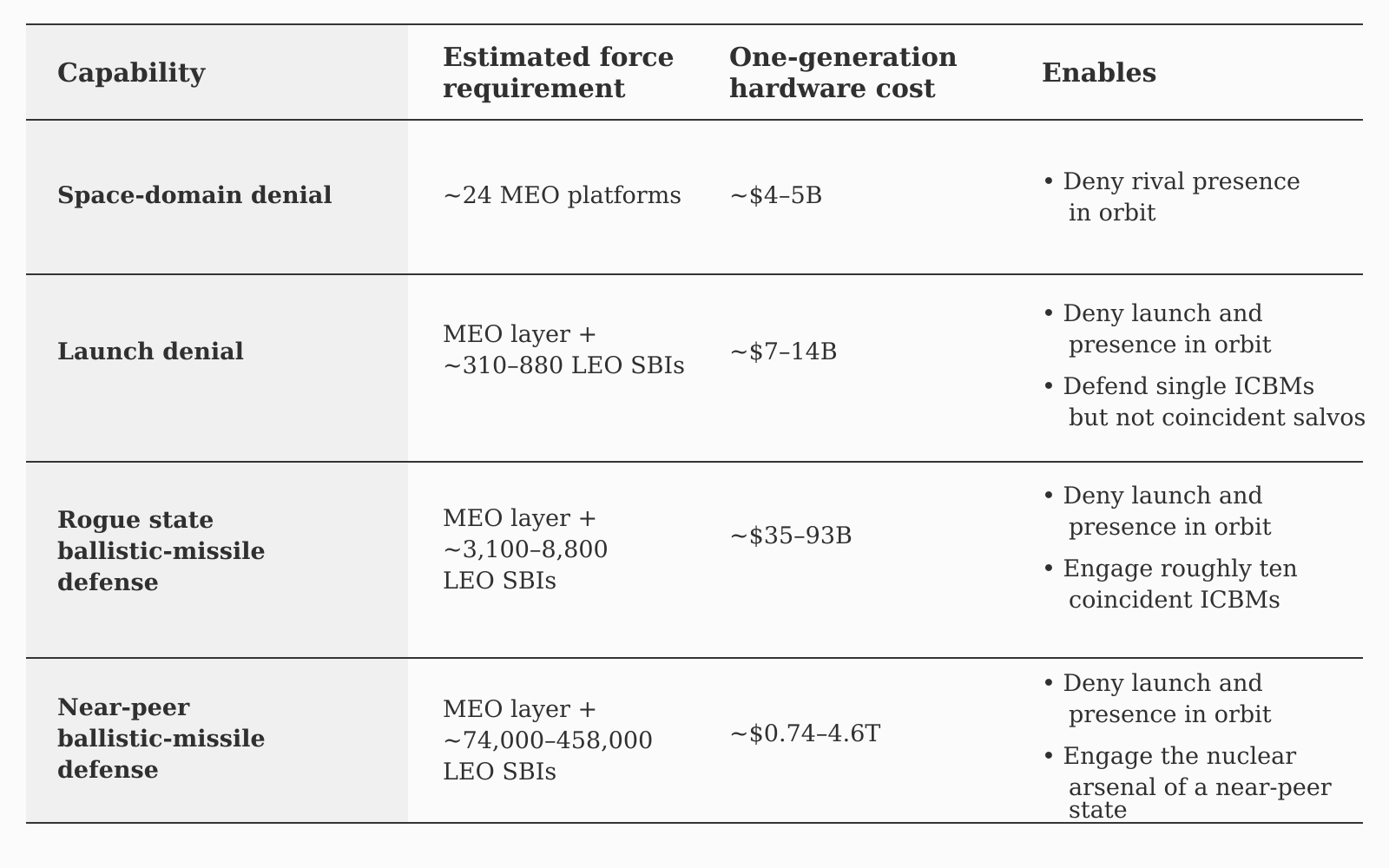
My bottom line for this section then is that the United States could probably field launch denial in the near future if it chose to. Initial layers look to cost in the low tens of billions, roughly 0.7–1.4% of one year’s US military expenditure, and well within what is already being spent on Golden Dome. Defense against a rogue state’s nuclear arsenal costs several times more but still looks feasible as a multiyear program, at roughly 3–9% of one year’s military expenditure. Defending against a near-peer costs many times more again, likely running into the trillions, equivalent to roughly one to five years of current military expenditure. Given this it seems likely that launch denial is within reach for the US within the next few years, though the US ultimately may prefer to employ only mild versions of it in order to avoid war with other nations.
Importantly however, the capability thresholds (including nuclear defense since the interceptors could engage ballistic missiles) arise from a continuous buildup of space-based weaponry which means the system itself is also entangled in and affects nuclear deterrence well before it is scaled up enough to stop a peer’s nuclear arsenal. In the next section I’ll look at how the build up of space weaponry would interact with mutually assured destruction.
Nuclear Deterrence
Space-based interceptors appear useful enough that the United States is likely to continue developing and deploying them. As the constellation grows, however, it would erode rivals’ confidence in their nuclear deterrents and give them stronger reasons to expand or redesign their arsenals, negotiate limits, or threaten war before the shield becomes decisive. How far this process went would depend above all on the speed of the buildup and how rivals responded. I see four main possibilities:
Arms race without breakout. On ordinary industrial timescales, a full shield would take years to build, giving rivals time to expand their arsenals and adopt delivery systems that route around it. Mutual deterrence would then survive, but in an altered and more expensive form. This represents a classic arms race scenario in which actors have incentive to race to preserve their security but attain no net benefit.
Breakout before rivals adapt. If, however, an Industrial Explosion lets the United States automate its military-industrial complex faster than its rivals and outproduce them, that build time collapses and a breakout from mutually assured destruction looks possible. Fielding interceptors in weeks or months rather than years could leave rivals too little time to adapt their arsenals. Decisions that would ordinarily involve months of assessment and negotiation would instead have to be made under extreme time pressure, potentially amid many other crises in the wake of transformative AI. The United States might present its rivals with a fait accompli, or a rival might strike preemptively before the shield was complete. We’ll consider what the world might look like if such a rapid breakout succeeded.
A new space treaty. On the other hand, rival states watching a shield go up would have strong reasons to demand a settlement before it was complete, with the threat of preemptive war looming if diplomacy failed. Because this would occur alongside a rapid expansion of military activity in space, the result might be a much broader bargain over weapons, access, extraction, and even the allocation or governance of large parts of space itself.
An unused advantage. Finally, we’ll consider the possibility that the issue never comes to a head. The United States might build up capability without using it to press for a decisive outcome, while rivals avoid the commitments that would force a confrontation. We’ll compare historical periods in which nuclear deterrence was absent or weakened but no state seized a decisive advantage with cases in which states did act as simple game-theoretic logic would seem to prescribe.
How do space-based interceptors erode nuclear deterrence?
There are two basic ways to break out of mutually assured destruction:
A disarming first strike. Advanced sensing could be used to locate ballistic-missile submarines and mobile launchers, which would then be destroyed alongside fixed silos before they could retaliate. Because launch-on-warning and launch-under-attack doctrines are intended to prevent this, such a strike would need to be nearly simultaneous and comprehensive.
A defensive escape. A sufficiently large mesh of space-based interceptors could instead engage and block incoming missiles, shooting them down in boost or during later stages of flight. In principle, this then allows an escape from MAD without requiring a first strike.
In practice, however, offense and defense reinforce one another. If a shield can intercept 10% of a rival’s full salvo, a disarming first strike needs to destroy only 90% to succeed.20 Hence, as the constellation grows, the residual force that a first strike must eliminate is steadily shrinking. As the launch leader builds out its shield, its prospects in a nuclear war would steadily improve, bringing it closer to the point at which a disarming first strike would be decisive. Once it reached that threshold, it would face a choice to launch the strike or hold that option in reserve.21 If deferred, then the launch-leader expects to enter a regime in which it can enact a strike at will but is itself strike immune or has strong damage limitation.
A rival would see the same process in reverse. As confidence in its retaliatory force eroded, it would face increasing pressure to expand its arsenal, develop delivery systems that route around the shield, negotiate limits on construction, disable the system, or strike before it became stronger. The buildup can therefore destabilize well before the shield becomes complete. How dangerous this is seems to depend largely on speed: whether rivals have years to adapt, or only weeks or months amid the wider disruption of an Industrial Explosion.
Is it possible that MAD could break faster than states could adapt or react?
On conventional industrial timescales, a near-peer shield would require at least tens of thousands of interceptor missiles22 and likely take years (e.g. perhaps 4–8) to produce, giving rivals considerable warning and time to adapt. A US lead in launch capacity, such as one enabled by Starship, could compress the shield’s final deployment into a campaign lasting only weeks or months while an asymmetric Industrial Explosion could compress production as well. The latter makes breakout before an effective response plausible, whereas a launch lead alone seems unlikely to enable an escape from nuclear deterrence. The two scenarios below illustrate the distinction.
Using only its launch lead, a savvy and ambitious US discreetly stockpiles a near-peer shield, then fields it in a rapid and ambiguous launch campaign. The United States could downplay its ambitions and publicly fund a modest, slow-growing defense against rogue states, à la Golden Dome, while a hidden effort invests heavily in producing the hardware for a full near-peer shield. Once Starship reached a high launch cadence, the United States could openly field a rogue-state-level system of roughly 3,100–8,800 interceptors. Then, having covertly accumulated the remaining hardware, it could execute an ambiguous launch campaign that installs the full constellation in as little as two months. The launch rate itself might be no higher than normal commercial cadence at that time, and with few transparency requirements governing what goes into orbit, the payloads could be described as military communications satellites.23 Analysts in rival states would debate whether they contained interceptor missiles and try to estimate the constellation’s actual capability. They might have only weeks to decide whether to force a launch moratorium before the shield was complete. The difficulty is that Starship compresses launch, not production. A near-peer shield would still require many aerospace contractors to produce tens of thousands of missiles over several years, at a hardware cost likely running into the trillions. Concealing the final launch campaign might be possible; concealing the procurement, factories, testing, and mobilization behind it would be much harder. For the gambit to work, the United States would need either to conduct something approaching a wartime mobilization discreetly for years or to have anticipated the economics of Starship and begun stockpiling long before the opportunity became obvious. Otherwise, rivals would likely have time to expand or redistribute their arsenals, develop alternative delivery systems, or force the issue diplomatically. A Starship-only breakout therefore looks possible in principle but unlikely to succeed.
In a Starship-and-AI enabled scenario, an asymmetric Industrial Explosion lets the United States build and field a near-peer shield much faster than rivals thought possible. If the United States begins with leads in both launch capacity and military automation, it could potentially funnel rapidly expanding automated industry into producing interceptors and satellites, faster than rival arsenals could adapt. The launch campaign would still purport to be a military communications or commercial mega-constellation. Rivals could threaten preemptive war, but uncertainty about whether the United States intended to break deterrence, whether the attempt could succeed, and how quickly the decisive threshold was approaching might delay their response. The most natural demand would be a launch moratorium, since launches are an observable and verifiable gate between a stockpile and an operational shield. A moratorium would freeze the fielding of the system, however, not remove the underlying capability. If the interceptors had already been built, the United States could remain one short launch campaign away from breaking deterrence. Rivals would then have to maintain a hair-trigger posture, demand intrusive and continuing verification, or develop weapons that route around the shield.
This sort of crisis scenario is of particular concern since humanity has so far survived its nuclear near misses, in part because leaders had time to assess ambiguous evidence, communicate, and step back. An Industrial Explosion could instead compress a succession of grand challenges such as new weapons of mass destruction, other sudden shifts in power, space races, and epistemic disruptions, into the same short period. A shield going up in orbit could therefore confront governments whose attention and decision-making capacity were already badly strained, making delay or miscalculation more likely.
Overall it seems that a US launch lead alone probably does not provide enough surprise for a successful nuclear breakout. An asymmetric Industrial Explosion in which the United States begins with leads in both launch and automation and converts them into physical military output faster than its rivals looks like it would potentially enable a break from MAD however. If that fait accompli succeeded, a rival would have few clean ways to rebuild deterrence. A matching orbital system would be largely foreclosed as an option because the launch-leader could deny rival space launches and access to orbit, leaving the rival to route its arsenal around the shield using atmospheric or unconventional delivery systems such as hypersonic cruise missiles or drones. If it could not establish a credible counter-threat before the shield was combined with counterforce capabilities, the preemptive logic would reverse: the United States could threaten a decisive first strike and demand assurances that the rival would not attempt to restore its second-strike capability.
Would the erosion of MAD force a Grand Bargain?
Rather than accept that post-MAD order, rivals could try to force a settlement before the shield was complete, using the threat of preemptive war as leverage. The form of the negotiation would be a bargain under two-sided private information. The United States would know more about the shield’s actual capabilities and its willingness to pursue breakout, while its rivals would know more about their countermeasures, red lines, and willingness to escalate. The bargain would ultimately be backstopped by each side’s expected outcome in an unconstrained conflict since either party can reject terms it regards as worse than going to war.
The immediate problem would be drawing a verifiable line between limited defense and full nuclear breakout. A deal that could resolve this would be a verification regime. Because the launch-leader’s advantage is gated by an observable action (launching weapons into orbit) the rival could in principle demand a launch moratorium or payload inspections. Stability would require the breakout time to a fielded shield to exceed the time the rival needed to detect a launch surge and respond. In general, an Industrial Explosion could create many other military risks arising from rapid industrial, economic, and technological growth and we do not investigate whether credible commitment or verification mechanisms could be found for all of them.24 What does seem feasible, however, is a transparency agreement covering the weapons sent into space. If the parties could verify when weapons relevant to deterrence were launched and remain confident that they had ample time to respond, MAD might remain stable beyond the point in time when these weapons become fieldable.
There is also a key historical precedent for new space capabilities that threatened nuclear stability and prompted a sweeping agreement. Within six years of Sputnik, the United States and Soviet Union had backed a 1963 UN resolution against placing weapons of mass destruction in orbit. Four years later, the Outer Space Treaty made that prohibition binding and went much further, establishing foundational rules for space including free access and use, no national appropriation, and the peaceful use of celestial bodies. We can call a similarly sweeping agreement intended to preserve stability through an intelligence or Industrial Explosion a Grand Bargain.25 Because the negotiations would occur amid great uncertainty during a rapid expansion of military and industrial activity in space, states seeking to preserve their security and relative influence might bargain over far more than the nuclear crisis that prompted them. A Grand Bargain updating the Outer Space Treaty could therefore shape how space is accessed, governed, and used, with major implications for the long-term future.
A few features would influence the terms of any agreement, and the launch-leader’s hand may be the stronger overall:
Bargaining leverage shifts as the shield grows. Early in the buildup, rivals retain an intact deterrent and can credibly threaten catastrophic escalation if construction continues. Each additional layer of defense, however, reduces the United States’ expected losses relative to theirs. As the system approaches breakout, the United States’ alternative to a deal improves and its bargaining position becomes progressively stronger.26
Time also favors the launch-leader, pressing rivals to draw clear red lines quickly. The launch-leader’s prospects improve continuously as the constellation grows, so it gains by stalling. Anticipating this, the launch-leader might accompany the buildup with significant misdirection (e.g. downplaying or obscuring the system’s capabilities) to delay the moment at which a rival forces negotiations. Rivals face the opposite pressure, needing to negotiate early and impose an immediate moratorium on launch, or risk bargaining from a much weaker position later.
Coalition building could favor either side. Third parties in the negotiation might tilt the balance either way. A bid to escape mutual deterrence is a legible threat around which other states might balance, producing a broad coalition against the United States. A counter from the US would be to project strength. It can offer early backers protection under its nuclear-defense umbrella and favorable terms in the post-MAD order that would arise if it succeeded. If these offers appeared credible, other states might instead bandwagon with the expected winner. The United States might also make balancing and preemption less attractive by presenting the system as a general security guarantee rather than a bid for unconstrained supremacy. If, for example, the United States pledged to intercept unprovoked missile attacks against other states as well as itself, preserve peaceful access to orbit, and give other powers visibility into the system’s scale and rules of engagement, it could reduce pressure for balancing or preemption. Though such commitments would not by themselves dissolve the security dilemma, and absent verification, rivals would still have strong reasons to counter build, seek alternative delivery systems, demand inspections or numerical limits, or organize a balancing coalition.
Bargaining, breakout, and preemptive war are not the only possibilities, however: it’s also possible that either side could ultimately stop short of forcing the issue. Game-theoretic logic can make a closing window seem to demand immediate action, yet states have often stopped short of its apparent prescription historically. John von Neumann, who helped invent the game theory this section draws on, believed that the United States should strike the Soviet Union before it acquired a secure deterrent, famously arguing: “If you say why not bomb them tomorrow, I say why not today.” But the United States did not do so during its four-year nuclear monopoly or the prolonged period of nuclear superiority that followed. Kennedy later considered limited first-strike options during the Berlin Crisis but did not adopt them. Later the United States also considered attacking China’s emerging nuclear program in 1963 and 1964 but ultimately tolerated its development rather than risk hostility. These are examples of a strategic advantage going unused even as that advantage is eroding. China for its part then did not even make securing a nuclear deterrent an overriding priority after developing its first nuclear warhead. In fact, it remained vulnerable to a first strike for more than three decades, and its retaliatory capability was still far from assured in 2010, but this seeming vulnerability was not exploited.
On the other hand the Cuban Missile Crisis saw the United States draw a hard line and accept a serious risk of nuclear war to reverse a sudden shift in the strategic landscape. Ultimately the historical record can’t definitively establish restraint as the default and it’s unclear how decision makers would react to the emergence of space weapons. History does show that the starkest game-theoretic prediction is not necessarily inevitable or even likely however. We can say that the drive either to secure deterrence or to exploit its weakness depends on how necessary states believe action to be and what they expect it to cost. Given this, it’s plausible that the constellation gets built while rivals respond with countermeasures and political pressure but never draw a decisive red line. Whether through that partial check or its own restraint, the United States might then extract only some of the advantages of a nuclear defense without attempting a complete breakout. In essence the possible advantage can remain incompletely challenged or incompletely used since either side may judge the risks of forcing a conclusion greater than the benefits.
In summary, a bargain might not be reached because the United States achieved breakout before rivals could strike or otherwise halt the buildup, or because negotiations broke down and led to war. Even if both sides preferred an agreement, verification would remain an open problem: launches are quite observable, but payload ambiguity, hidden stockpiles, or rapidly expandable production could make it difficult to ensure adequate warning for breakout. If negotiations overcame these problems, however, the resulting settlement could reach far beyond nuclear deterrence: like the Outer Space Treaty before it, it might establish new rules governing military power, access, and resource use across space.
Conclusion
Under the architecture modeled here, I estimate that roughly two dozen platforms in medium Earth orbit could provide a foundation for attacking and defending orbital assets, while a few hundred interceptors in low Earth orbit could add global launch denial. At an estimated one-generation hardware cost of roughly $4–14 billion, these capabilities fall well within existing US military expenditure and could plausibly emerge in the late 2020s or early 2030s if current development continues. Rival states have several potential countermeasures, including cyberattack, jamming, deliberate debris creation, and attacks on launch infrastructure, but it seems likely these do not overturn the potent underlying advantage conferred by a large and persistent lead in launch capacity.
Defense against a near-peer nuclear arsenal is a different proposition. A near-peer nuclear defense might require 74,000–458,000 interceptors and cost $0.7–4.6 trillion. Given ordinary wartime mobilization, producing that force might take something like four to eight years, giving rivals time to expand their arsenals, develop delivery systems that route around the shield, or force negotiations. US launch lead compresses deployment rather than production and therefore seems unlikely to enable a successful nuclear breakout on its own. If the United States entered an Industrial Explosion with initial leads in both launch and military automation, however, it might compress both stages and outproduce its rivals before they could respond. Particularly if the shield emerged amid several simultaneous crises and strained governments’ ability to interpret events and coordinate, a rapid break from mutual deterrence looks plausible.
The ultimate outcome prompted by the US making use of its launch lead for military advantage looks open to several main possibilities. Rivals might preserve deterrence through an expensive arms race, threaten preemptive war, or force negotiations before the shield was complete. A successful settlement might grow into a Grand Bargain governing not only missile defense but military activity, access, and resource use across space. Alternatively, we might ‘muddle through’ with rivals partially checking using modest countermeasures and political pressure but not drawing a decisive red line, or the United States extracting some advantages from placing weapons in orbit but not attempting a complete breakout.
A preferable US strategy could be to capitalize on its launch lead while seeking some verifiable line short of a full, near-peer-deterrence-breaking shield. The United States could continue expanding launch capacity and protecting its orbital infrastructure, offer defense against rogue state arsenals, and commit to preserving peaceful access to space. Avoiding a security dilemma, however, would also require transparency about military payloads. Whether such arrangements prove feasible is uncertain, but the stakes do extend beyond nuclear stability. Since space weapons appear useful and increasingly affordable, their development may be difficult to avoid, and the rules established around the first large-scale military constellations could shape both the nuclear order on Earth and the governance of economic and military activity across space.
Appendix A: Space and Counterspace Weapons and a Trench Model of Orbital Warfare
Space and counterspace today
We can first survey current and emerging space and counterspace weapons; we’ll sort them based on which orbital regime they can threaten and see if an actor with a minority of launch capacity could deal outsized damage that the launch-leader would have no response to. If this is not the case it seems likely that a launch-leader who can field many times more orbital assets and do so more rapidly and more flexibly than other states would be able to dominate in orbital warfare if conflict emerged.
A key point is that counterspace weapons are frustrated by distance. Currently, demonstrated kinetic anti-satellite intercept has occurred only below ~900 km. Ground-based lasers can dazzle sensors in low orbit and may eventually scale up to inflict physical damage, but both laser and kinetic attacks become progressively more difficult against targets in higher orbits because of the greater range, energy, and—for kinetic systems—delta-v required. It seems altitude would buy significant protection for a launch-leader, who could exploit this by distributing and defending assets across orbital regimes, creating a position that is difficult and costly for a launch laggard to challenge from the ground.
Space assets are vulnerable to a variety of attacks, surveyed in the table below, and it helps to separate three grades by how permanent they are and whether they leave behind debris which could cause additional collisions in orbit.
Temporary impairment (e.g. jamming a satellite link or dazzling its sensors with low-power lasers) suppresses an asset’s function while the attack lasts, then it recovers. These roughly tend to be cheap, reversible, and deniable. They are the most mature and most routinely used counterspace weapons.
A soft kill permanently disables the spacecraft without breaking it up, so it leaves no debris.27
A hard kill physically wrecks a spacecraft by kinetic impact or fragmentation; it is permanent and, unlike the other two, scatters debris that can then threaten other satellites in its orbital band.
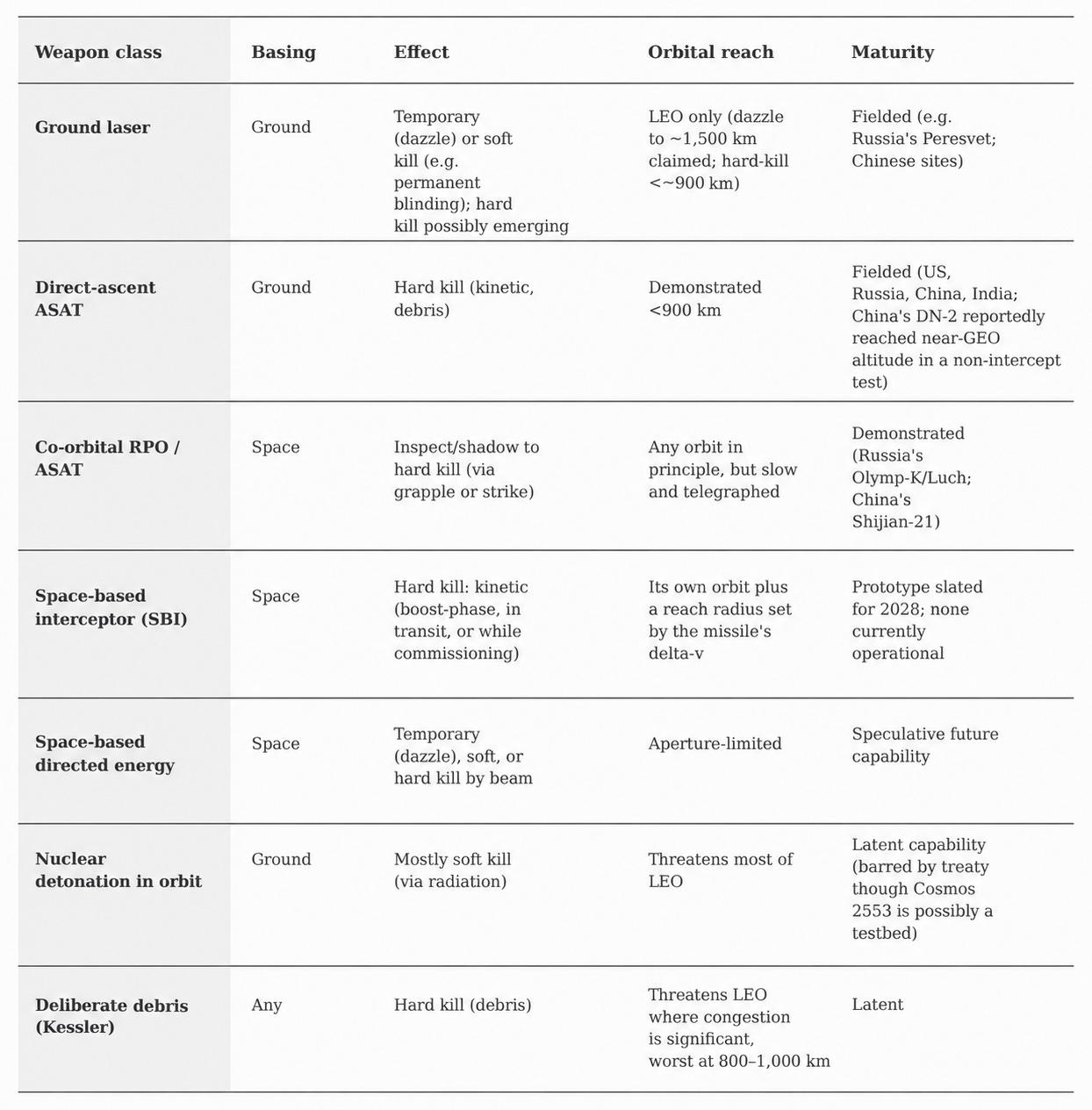
The strongest potential equalizers would be a nuclear detonation in orbit or the deliberate creation of debris in a congested LEO band. Either would indiscriminately disable satellites belonging to many nations, so its use is a major international incident rather than a clean attack on the launch-leader alone. The resultant debris could persist variously for months to centuries depending on altitude, would be a major economic catastrophe, and would complicate but probably not prohibit space activity beyond low Earth orbit thereafter. A sufficiently large nuclear burst might disable roughly 20% of LEO satellites promptly and perhaps many more over time through an artificial radiation belt, with estimates approaching 90% of unhardened LEO satellites. Ultimately this doesn’t seem to block a launch-leader from being able to attain dominance in orbit however. In particular, systems in higher orbits (such as GPS) are beyond the threatened debris bands and generally more hardened. A launch-leader anticipating this systemic risk in LEO has the option to distribute critical assets across altitudes (e.g. VLEO, MEO, and GEO), leaving it with the largest surviving orbital presence after an attack and also the greatest capacity to rebuild after such an attack. Even so, this remains a significant check on the launch-leader: roughly 94% of active satellites are currently in LEO, so a leveling attack across the principal bands could destroy tens of billions of dollars in orbital infrastructure and impose still larger downstream losses across communications, imaging, weather forecasting, and military operations.
A second important class is cyber and electronic attack since these attacks can be very low cost. Directly hijacking a hardened military satellite over its radio command link appears difficult: modern military satellites employ authenticated and encrypted links, and no public case appears to show an adversary commandeering a hardened spacecraft. What seems more feasible is attack on the ground segment, supply chain, and vulnerability to jamming, which is where satellite compromise has happened to date (for example, in the Viasat hack, or the OPS-SAT demonstration). Overall cyber and electronic warfare currently seems like a threat that can degrade availability at the margins (e.g. via jamming a link or blinding a ground station) but can’t cheaply seize or disable hardened war-fighting assets.28
A trench model for orbital warfare
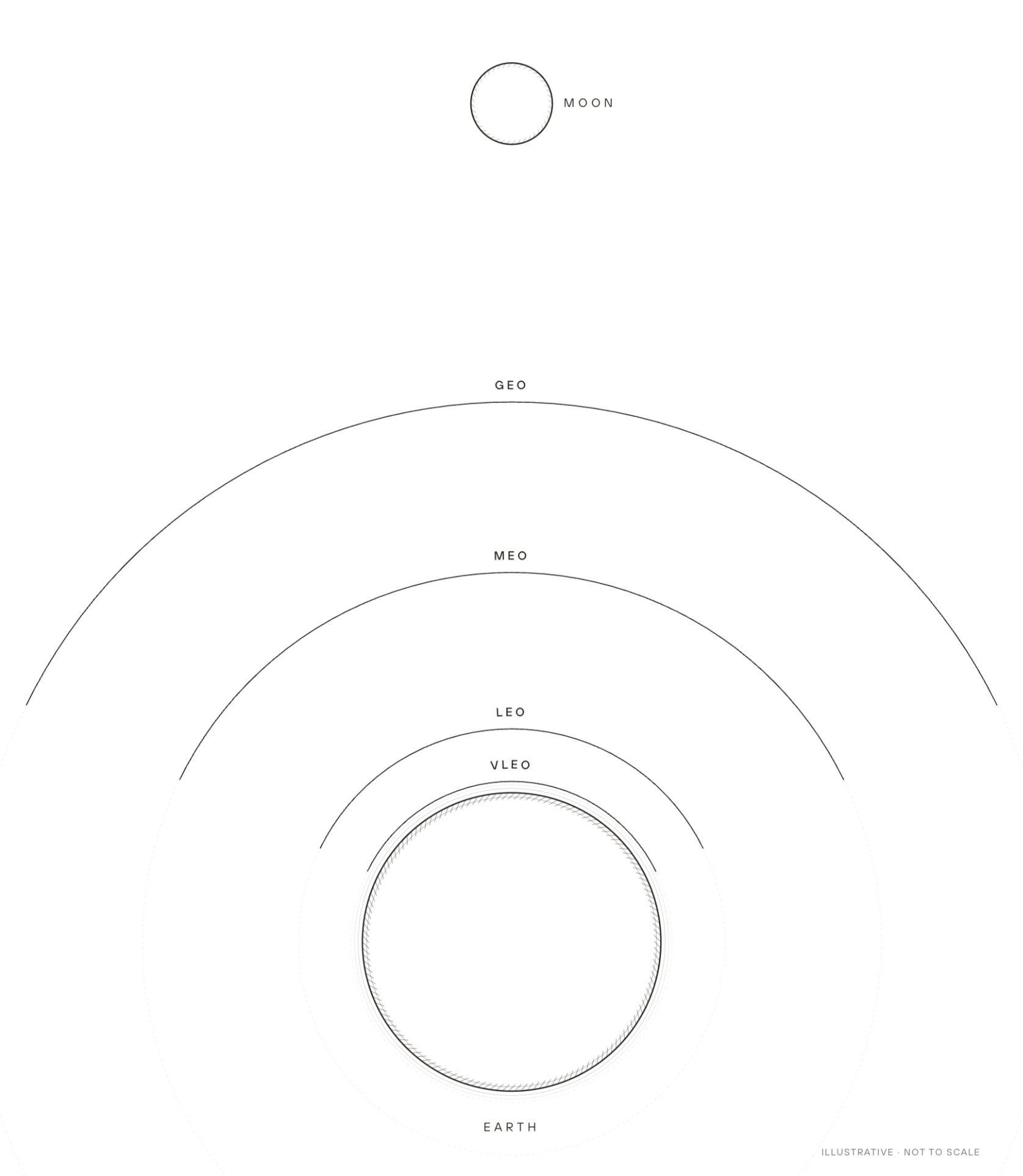
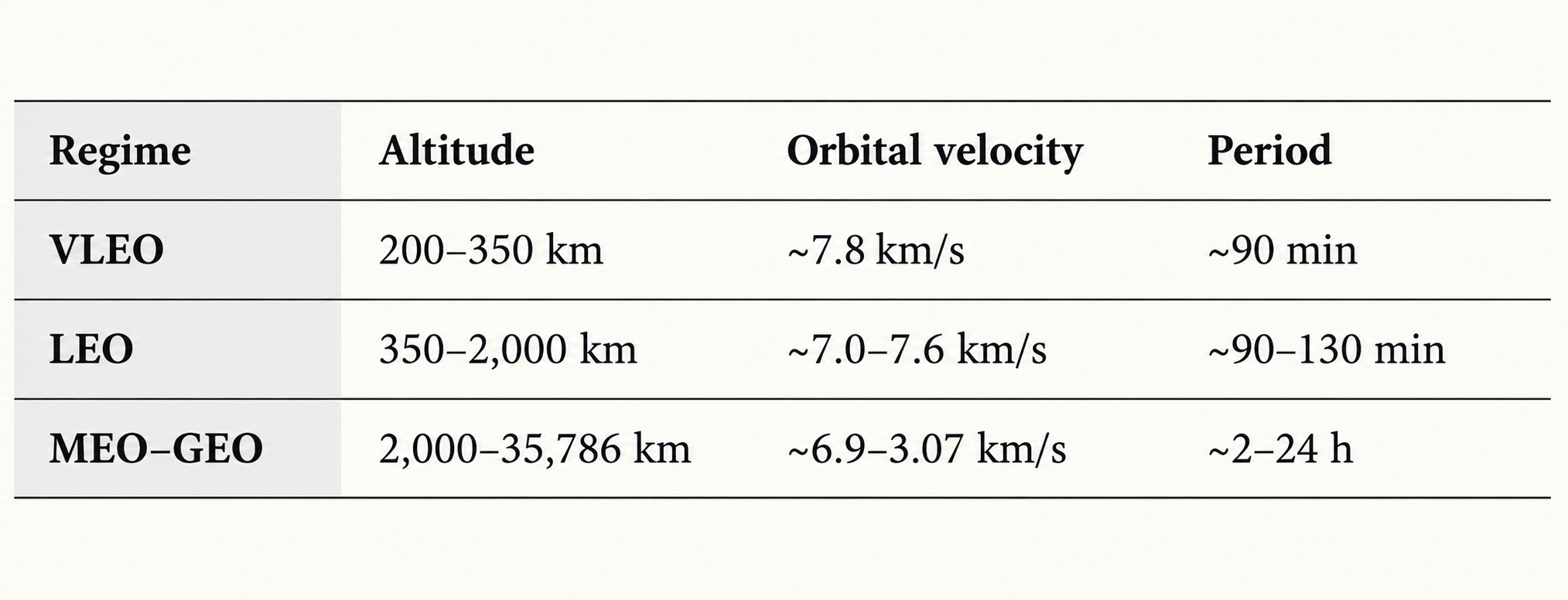
The launch-leader’s natural move would be to stage assets in depth across orbital regimes—a sort of trench model, in the sense that several independent lines of defense each do a different job and fail to a different attack, and this seems workable overall. We can briefly look at the characteristics of different regions of Earth orbit:
Very low Earth orbit (VLEO, 200–350 km). Very low Earth orbit sits close enough to strike ground-based counterspace sites and to intercept boosting rockets. Debris at this altitude is self-cleaning as the rarefied atmosphere drags and de-orbits it (decaying in days to weeks) so that it leaves no lasting wreckage. But for this same reason, assets in VLEO must boost periodically to keep from de-orbiting and its lifetime would be set by the fuel it keeps to sustain these orbit maintenance boosts: depending on design and altitude, this can generally be a period of months or years. This is the layer most exposed to ground fire.29 VLEO then likely functions as a cheap, consumable forward layer. Its proximity to the ground gives the best reconnaissance resolution, the lowest latency, and the shortest weapon time-of-flight to the ground or to a boosting rocket.
Low Earth orbit (LEO, 350–2,000 km). LEO by contrast sits at higher altitude where orbits can be more easily maintained. This is where boost-phase interception likely happens. Interceptors in LEO should also be capable of self-protection against direct-ascent anti-satellite weapons. Before it can close on a particular platform, the attacking weapon advertises itself as a bright, accelerating, and predictable booster. Assets in LEO do likely stay exposed to ground-based dazzlers and potentially to future directed energy weapons. Given that the overwhelming majority of satellites also sit in LEO currently it is broadly just this region that is at risk from large-scale debris cascades.30
Medium and geosynchronous Earth orbits (MEO / GEO, ~2,000–36,000 km). Assets here sit too far out for use in missile defense on Earth but could enable an actor to prevent a rival from commissioning satellites, attack or defend orbital assets, and deny transit through space beyond Earth. This high ground looks difficult to assail with ground-based attack and could confer command of the space domain. Weapons staged here seem able to attack and defend satellites, but it is not functional as a shield against ballistic missiles on Earth and cannot strike Earth promptly. Its role is likely to protect one’s own reconnaissance, timing, and communications while denying an adversary theirs, which could be decisive in modern warfare.
Seizing the high ground
Based on this a potent move would be to seize the high altitude orbits beyond all demonstrated destructive ground attack. Once established, attacking from Earth remains possible in principle but requires a conspicuous high-energy ascent through defended orbital layers. At 20,000 km as few as one or two dozen platforms spread across several inclined planes seems sufficient to provide global coverage.
Possible counters don’t look too promising. Direct ascent attacks to reach these high orbits could be countered by interceptors at this layer or potentially by a LEO based layer during boost. An alternative counter could be the development of more powerful ground-based lasers, but the diffraction-limited intensity on target drops off with the square of the distance. Hence a beam that dazzles a satellite at 1,000 km is about 400× weaker against one at 20,000 km. Concretely, even a perfect 4 m adaptive-optics ground laser, assuming no atmospheric loss at all, would need about 1.2 MW to put dazzle-level flux (about 1 W/cm²) on a target at 20,000 km, and perhaps 1.2 GW to reach a killing flux (about 1 kW/cm²). The latter however is around a thousand times beyond any laser ever built, and in practice looks mostly undeliverable from Earth, since atmospheric thermal blooming defocuses a high-power ground beam long before it reaches such intensities.31 So a shell at 20,000 km looks very difficult to assail from Earth unless physically ascending assets can overpower the prepositioned assets striking down at them. Direct ascent weapons are deeply disadvantaged in that exchange however due to their needing to climb out of Earth’s gravity well.
Because a plane change in orbit costs 2·v·sin(Δi/2) and orbital velocity is low up high (about 3.9 km/s at our 20,000 km layer against 7.6 in LEO), an interceptor reorients to a target’s plane fairly cheaply at altitude and then drops. Striking a LEO target seems feasible from as little as about 1.4 km/s for an equatorial one up to about 7 km/s for a polar one,32 with the descent itself taking about three hours from MEO. The high shell therefore seems like it may be able to hold any object in LEO at risk. If this is true it would be possible for the launch-leader to deny successful commissioning and operation in space by killing a satellite in orbit or a spacecraft as it heads outbound (e.g. to the Moon).
How costly would it be to set up?
The core concept governing the cost-exchange in orbital warfare is the absentee ratio. A satellite in low orbit is over any given point on Earth only a few percent of the time, so keeping one continuously within reach of a target requires having many assets staged on orbit. Importantly, the absentee ratio depends on how fast the strike needs to land. Denying a launch means killing the rocket during its ~3-minute boost phase, which demands an interceptor already overhead, no more than a few hundred kilometers away and hence hundreds of them are needed for continuous global coverage. Striking a target deeper in space that is already in a known orbit or trajectory instead gives you days to weeks to strike, which then means a mere handful of higher-orbit platforms could provide coverage.
A single MEO platform has line of sight to about 58% of the entire LEO shell at once, and a constellation of perhaps just two dozen platforms sees every point in LEO from a dozen or more angles continuously. Because an object remaining in a known orbit is predictable and offers repeated node crossings, the defender can wait for favorable phasing and spend delta-v to close. A commissioning satellite is especially exposed, being large, sunlit, and under continuous low thrust.
This could be built from the high ground down, in two stages. The first stage is the modest set of platforms in MEO. They cannot strike quickly, but they can attack and defend on orbit while sitting beyond the practical reach of ground attack and from orbit they deny a rival access to the regions both below and above them. This alone seems to plausibly buy a strong space-domain-denial capability for an actor with superior launch capacity. The second stage then could scale down into LEO, where a much larger, more exposed screen adds fast, boost-phase missile defense on Earth. The net effect is that the low-lying layer for Earth-based missile defense is the expensive one while a high-altitude layer for attack and defense of orbital assets looks comparatively cheap.
We can compare cost estimates against a budget. US GDP is on the order of $30 trillion, while the US Space Force budget today is roughly $40B. On that scale the whole trench costs less than a single year of existing space spending—and even the rogue state nuclear tier ($31–88B) is a few months of a 1%-US-GDP commitment. Only leakproof defense against a full nuclear peer ($0.7–4.6T) amounts to a multi-year fraction of national output.
Importantly, space-based interceptors are still at the prototype stage. Even if launch becomes cheap and abundant, early fielding could instead be limited by interceptor manufacture and by payload integration and testing. Space Force has spread up to $3.2B across twelve companies (among them Lockheed Martin, Northrop Grumman, Raytheon, Anduril, and SpaceX) with a flight test slated for 2028 to decide which designs advance. So while the raw cost of missiles and the launch required to field them looks small, R&D slippage, cost overruns, or outright cancellation all seem plausible. Secondly, boost-phase intercept and on-orbit attack and defense are not mature, demonstrated capabilities so while I’d argue these capabilities look surprisingly potent and affordable, ample uncertainty about whether they in fact pencil out remains.
But who wins on the marginal exchange and in a war of attrition?
It could also be that these kinds of military advantages are affordable to field but not affordable to sustain, i.e. the more important overall measure could be the cost-exchange ratio (i.e. the launch-leader’s marginal cost to negate one more of a rival’s vehicles, against that vehicle’s own cost).
Space-domain denial (i.e. denying a rival presence in orbit) runs in the launch-leader’s favor. Two interceptors (call it $20–44M) could destroy a launch and payload worth anywhere from about $100M for a routine satellite to billions and up for major orbital infrastructure or a deep-space mission. A good guess then is that space-domain denial runs on the order of 2–100x in the launch-leader’s favor, depending on interceptor cost and how valuable the payload it kills is.
The launch-leader looks modestly favored in a war of attrition between space-based interceptors and anti-satellite weapons. A direct-ascent ASAT is a large missile that must climb all the way to the interceptor’s orbit. A trade should run in the launch-leader’s favor if supply chains are mature since the launch-leader amortizes the cost of climbing out of Earth’s gravity well over the many interceptors carried on a single launch while the direct ascent weapon can’t amortize because it would be struck down in the boost phase.
Leakproof nuclear missile defense is an expensive case, though who wins a single exchange is the decisive consideration rather than who wins a war of attrition in this case. For the case of missile defense on Earth costs balloon as the absentee ratio dominates, and the marginal cost exchange has to be read as the up-front cost of one more unit of guaranteed coincident capacity rather than the interceptors actually spent in any single engagement. A rival’s best move is to concentrate its entire salvo at the one least favorable launch point and instant, so guaranteeing the intercept of one additional simultaneous ICBM means keeping one more interceptor within reach of every launch point on Earth at all times (another N₁ ≈ 310–880 vehicles).33 Likely only one or two locally positioned interceptors are expended when the engagement actually occurs, but the whole added layer must be purchased to guarantee that kill: roughly $3.1B–$19B, against an ICBM worth about $160M. That is a cost-exchange of about 20–120× in the rival’s favor, so here the launch-leader is out-traded and would need wealth in excess to sustainably defend against a rival’s nuclear arsenal. An adversary content to poison the orbital environment may also be able to detonate a nuclear weapon in orbit or deliberately seed a Kessler cascade. Stopping that reliably would require the same leakproof, near-peer-scale defense, and this attack threatens roughly every asset in low Earth orbit. This doesn’t seem to kill the case for space-domain denial however. The relevant question for this case however is not if the cost exchange is sustainable over a prolonged conflict. As noted earlier in the post, if a launch-leader constructing the shield reaches the threshold where it can enact a partially successful first-strike then absorb a rival’s degraded second strike then the cost economics of an extended exchange are obviated because the launch-leader has deterrence against attack on its shield and can threaten a first strike.
Space-based directed energy weapons would also change the economics dramatically if developed, potentially in favor of the launch-leader or potentially in favor of counterspace depending on whether ground-based or space-based lasers mature faster. A kinetic interceptor is a multi-million dollar vehicle that is expended on use and takes minutes or hours to reach its target. A laser by contrast reaches targets at the speed of light and can be fired again and again. A hypothetical design that is not yet developed but seems feasible with significant R&D effort would be something like a 500 kW, 4 m aperture laser weapon. Prepositioned at MEO this seems sufficient to soft-kill a LEO satellite in tens of seconds to a couple of minutes across some 25,000 km of slant range. The mature version of space-domain denial might then be a modest constellation of directed-energy platforms controlling traffic beyond Earth. A solar-powered laser’s marginal shot is cheap and its magazine effectively unlimited, so once high-power space lasers mature the exchange tilts toward the launch-leader. In vacuum there is no atmospheric blooming, so a laser achieves its diffraction-limited spot, and a single ~4 m, ~500 kW module seems deliverable in one Starship launch. This would be a big deal, potentially tipping the marginal cost-per-kill from a few million dollars per missile to just a few dollars per shot. Today the best fielded laser weapons sit at around 60–100 kW, including Lockheed Martin’s HELIOS and Rafael’s Iron Beam. Lockheed also delivered a 300 kW-class laser source for weapon integration and is developing a 500 kW-class source. The 500 kW module is thus a few times beyond demonstrated terrestrial hardware but is on par with current R&D programs. Transitioning these designs for in-space operation at scale would also require significant R&D however. Nonetheless space-based laser weapons seem exceedingly potent and would be a big deal if constructed and fielded.
Appendix B: Sizing an Orbital Boost-phase Shield for Launch Denial and Ballistic Missile Defense
Here I’ll do back-of-the-envelope estimates for how many space-based interceptors would be required for each of three capability thresholds:
Launch denial. The ability to destroy an adversary’s rockets during boost, before their payloads reach a stable orbit.
Rogue state nuclear defense. Leakproof boost-phase defense against the small, co-located arsenal of a state such as North Korea.
Near-peer nuclear defense. Leakproof boost-phase defense against the full nuclear arsenal of a peer (for example, China or Russia) firing coincidently.
Let constellation size N be decomposed as:
Where N₁ is the number of satellites needed such that at least one is within lethal reach of any single boosting missile or rocket, anywhere on Earth. Since a low-orbit interceptor is over any given region of the Earth’s surface briefly, hundreds would need to be on orbit to sweep that region continuously such that an interceptor is guaranteed to be in range for any time of launch. Then depth, D, is the maximum number of missiles that can be launched simultaneously from within a single interceptor footprint. D is set by the densest possible launch site rather than by the total arsenal. For example, a coincident salvo of 1,000 missiles spread across many fields, ocean patches, and dispersal areas does not require 1,000-fold depth to intercept all 1,000. It suffices that no single footprint contains more than D coincident launches. Note N₁ does not specify the number of orbital planes or satellites per plane; I abstract this away for simple bookkeeping. The interceptor also isn’t bare and loitering in orbit, it would carry power, communications, attitude control, station-keeping, and thermal management systems. This forms the “lifejacket”, or garage, and the system needs N₁ garages each sporting D missiles.
To get estimates for near-term feasible interceptor designs we can look at existing missile systems:
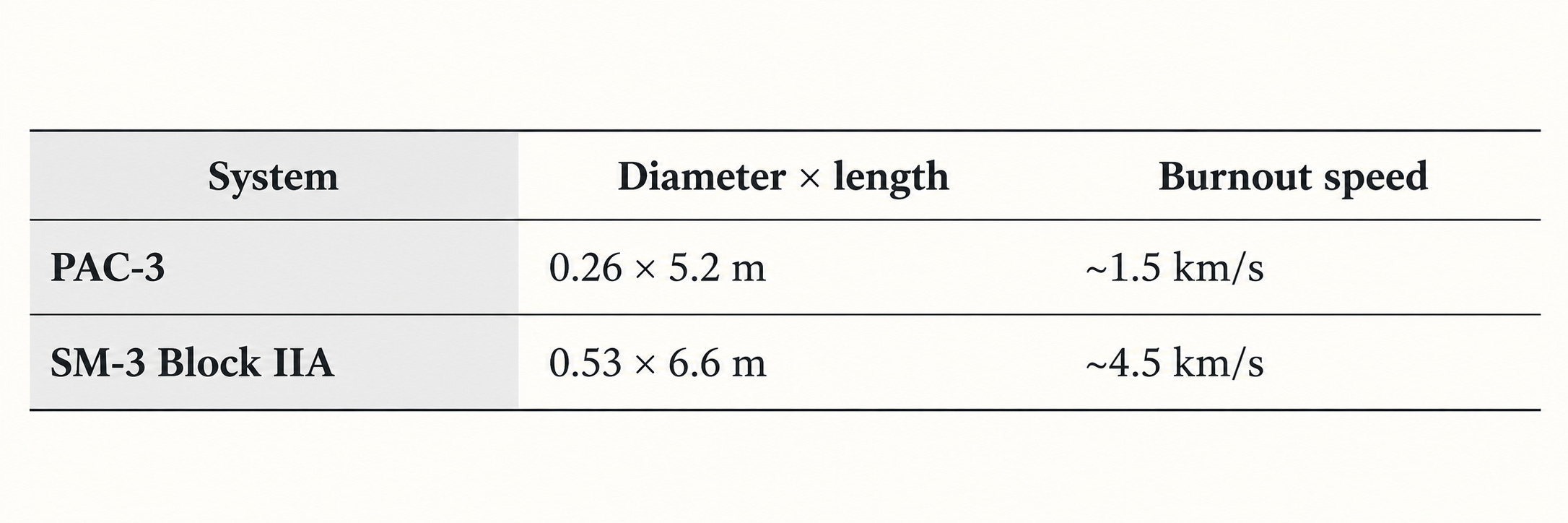
SBI missiles will be assumed to have a similar profile but gain speed by not needing to climb and by operating in low Earth orbit where atmospheric resistance is minimal. As interceptor speed increases, coverage can relax, decreasing the number of interceptors needed to create a full shield.
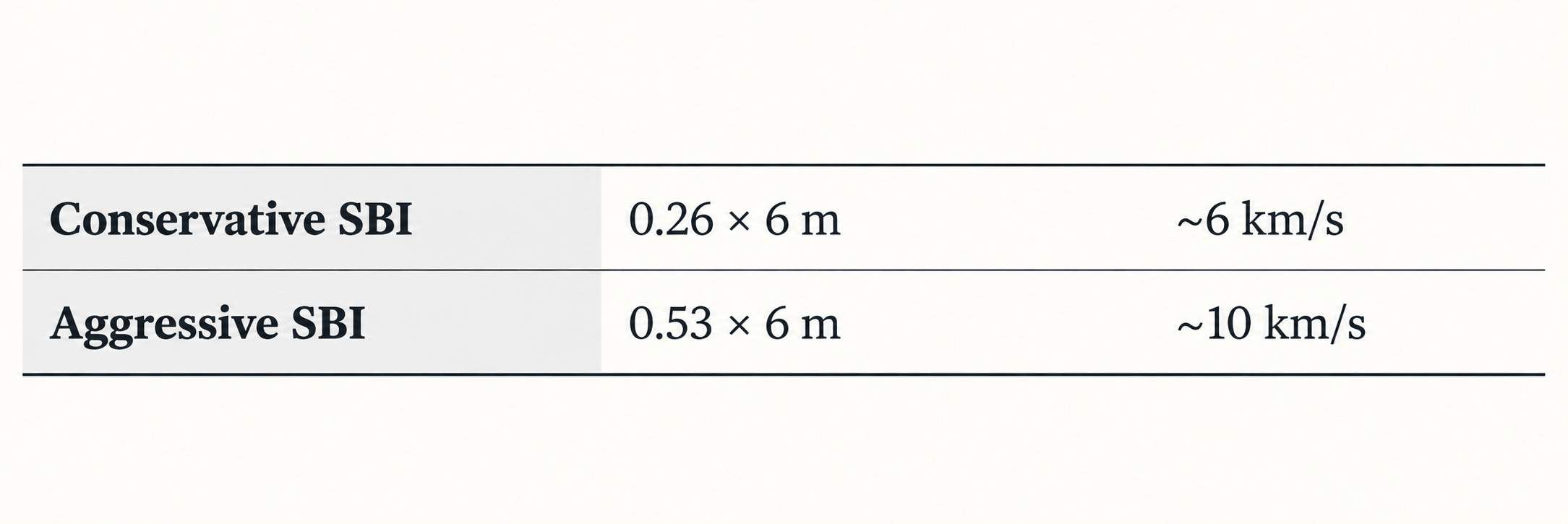
Take an interceptor at altitude h = 400 km, an engageable boost window after detection and fire-commit of t ≈ 150 s, and a kill-vehicle burnout velocity v. The lethal slant range is R ≈ v·(t − ½·tburn), and the ground footprint radius is ρ ≈ √(R² − h²), with cap area ≈ πρ². Global single-intercept coverage is taken to be N₁ ≈ (Earth area 5.1×10⁸ km²) ÷ (footprint area) ÷ (≈0.37 packing efficiency) based on a phased Walker-star constellation. I treat 0.37 packing as conservatively covering both spatial and temporal worst cases.
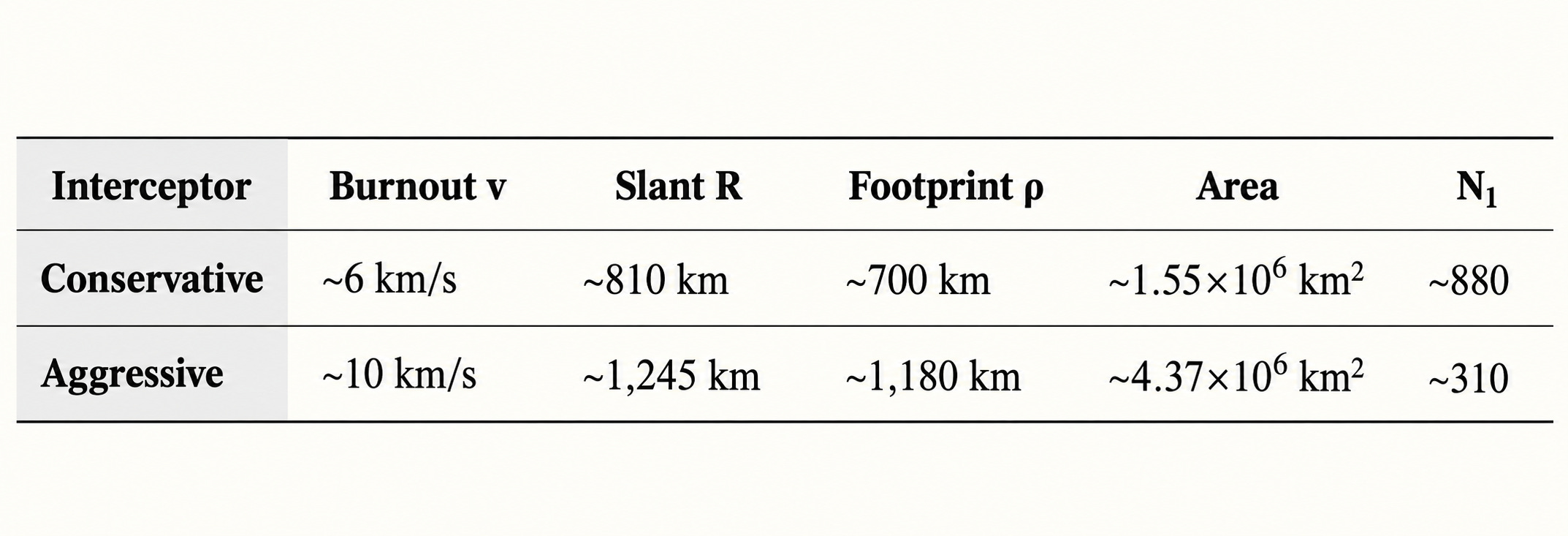
CBO’s architecture finds N₁ ≈ 390. I’ll carry N₁ ≈ 310 (aggressive) and N₁ ≈ 880 (conservative) as the working bracket, based on the above. Then we can bracket defense depth by capability level.
Launch denial (D ≈ 1). A space-launch vehicle does not deploy decoys; it ascends and accelerates toward orbital velocity for ~8–10 minutes and then is a single fragile object in a known orbit thereafter. Strictly, a platform need not be overhead at the launch instant to deny a rival useful access to space if anything that can reach the target’s orbit within hours also suffices but that is space-domain denial, provided by the MEO layer in the previous appendix. The 310–880 figure here prices the stricter capability of killing the rocket in boost; since a space-launch vehicle deploys no decoys and launches are rarely coincident, I assume a depth of one suffices.
Rogue ballistic missile defense (D ≈ 10). I’ll take the CBO depth assumption for a rogue state nuclear arsenal.
Near-peer ballistic missile defense (D ≈ 240–520). Total deployable ICBMs number in the hundreds for near-peer states. In general silos will have some density significantly less than the total deployable global arsenal, and mobile launchers are assumed to be spread out but could in principle concentrate to overwhelm the coverage at one point in the shield. For this reason I’ll assume a near-peer depth of D ≈ 240–520 as though the state fired its entire nuclear arsenal both instantaneously and from the same physical location on Earth. This forces the depth number high and drives up the total number of interceptors needed to reliably shield against a near-peer. Note also that this is conservative and not optimized: a power building the shield could reliably anticipate where silos are concentrated and maximize depth only at orbits crossing those regions. I assume the need for blanket continuous coverage at maximum depth everywhere on Earth. Variant architectures might combine a polar Walker-star with one or more Walker-delta constellations concentrated over latitude bands with high missile concentration. In addition, it may be possible to engage missiles over the midcourse phase giving many additional minutes for interception but forcing interceptors to either discriminate decoys or attack all decoys and warheads. If decoys can be detected, coverage can be relaxed substantially, but I assume they cannot.
The launch count to field the shield is N ÷ (interceptors per flight). Each conservative interceptor is assumed to weigh ~1 t and each aggressive one ~2.5 t (both including lifejacket), and because both are denser than Starship’s ~100 kg/m3 mass–volume crossover, packing is limited by mass, not volume: a ~100 t reusable Starship carries roughly 100 conservative or 40 aggressive units per flight.
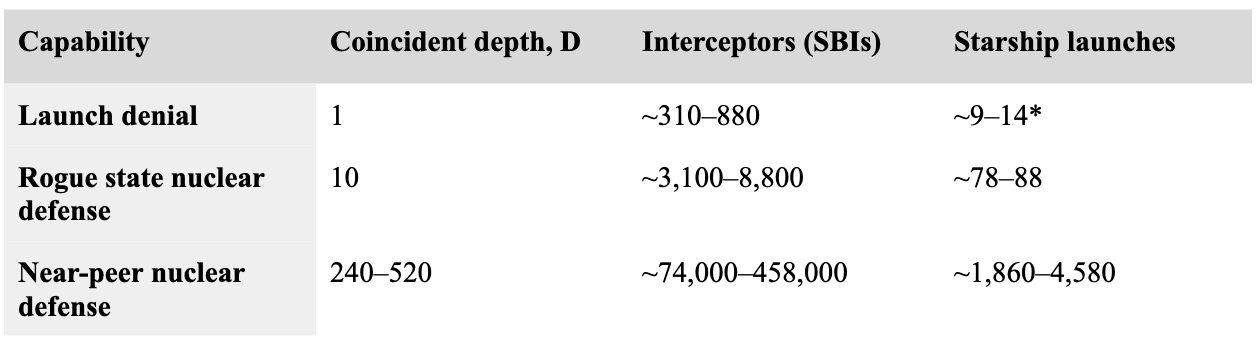
The launch campaign duration follows from the forecast for Starship launch rates. Although 310–880 interceptors would fit by mass in roughly 8–9 Starship payloads, distributing them across the required orbital planes raises the estimated campaign to roughly 9–14 launches; the asterisk marks this plane-placement constraint.

It’s quite notable that if the more aggressive ends of this range can be reached the time to break mutually assured destruction can be very short from the perspective of an adversary. That is if space-based interceptors were built and stockpiled covertly, they could be launched and made operational in a very short timespan. Notably this would require a launch cadence around 50 times larger than any nation’s current space programs but this doesn’t seem beyond the reach of Starship a few years from now in principle.
The time to produce the interceptors would be longer. Missiles in this reference class are produced by the US to the tune of hundreds per year, while a serious wartime surge could plausibly reach tens of thousands per year. The US military-aircraft ramp in World War II could be an instructive precedent. Output ramped from ~19,000 aircraft in 1941 to ~48,000 in 1942 to ~86,000 in 1943, peaking near ~96,000 in 1944, roughly an annual doubling through the first two war years. I assume for simplicity that interceptor production could follow a similar trajectory in principle: doubling year over year toward a plateau on the order of ~100,000 units annually. For cost, I use CBO’s $22 million average cost per SBI as a conservative benchmark and assume that mass production could bring the mature cost of a complete vehicle, including its interceptor and lifejacket, toward $10 million. Launch at CBO’s assumed future heavy-lift cost of $500/kg would add roughly $0.5 million per one-ton SBI and $1.25 million per 2.5 t aggressive SBI, or around 5–12%.34
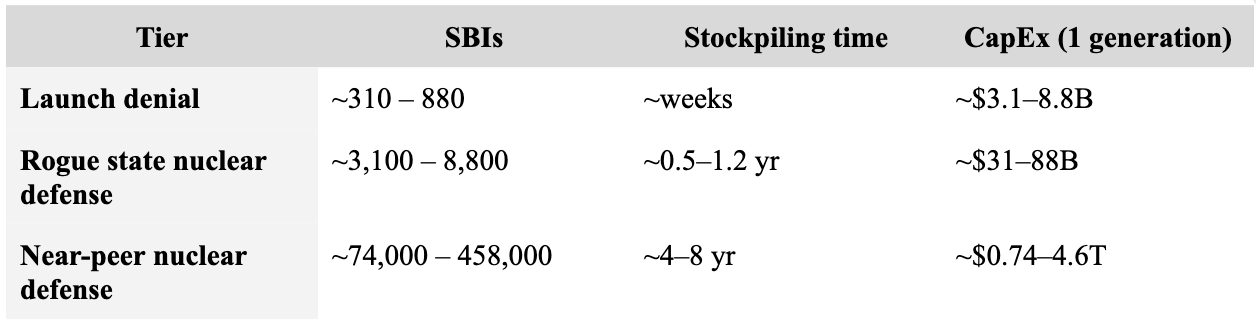
At this (fairly prodigious) wartime production rate, it seems unlikely that robust defense against a near-peer could be developed before the rival’s nuclear arsenal shifts its delivery system to at least partially counter the shield. Notably the US Golden Dome also includes multiple layers of ground-based missile defense which could blunt this, though the cost economics are worse since defense is regional and must contend with decoys and evasive maneuvers. Since the cost is large, the spending could not likely be kept secret enough to make this a surprise capability though some misdirection about quantity and time to completion might confer a strategic advantage. The above assumes conventional, if heavily surged, industrial rates, and on those rates it is production, rather than launch or financing, that gates a near-peer shield. But manufacturing throughput in an intelligence-and-Industrial Explosion may inflate intensely. Given automated design, fabrication, and assembly, interceptor output could run orders of magnitude above the WWII-analog rate assumed here, perhaps even collapsing the multi-year stockpiling figure toward the launch-limited floor of months. This could be blocked by other nations, however, by forcing early negotiations unless the surge in productivity is itself a surprise. Compared to the near-peer nuclear shield however, launch denial is extraordinarily cheap and defense against states with minimal nuclear arsenals also seems very feasible. A median outcome could be strong US space superiority, including space-domain denial and an option to add launch denial, while remaining checked by rivals’ nuclear forces.
This article was created by Forethought. See all our research on our website.
That is, conditional on Starship completing development and reaching reusability on par with or slightly worse than what SpaceX has done with Falcon, Starship’s heavy lift capacity alone looks sufficient to drive US share of global launch capacity to 99% or higher (by upmass). In 2025, SpaceX accounted for over 80% of global launch capacity by mass and Starship aims to make step changes in payload per flight, reusability, manufacturability, and turnaround time simultaneously. Non-US companies are broadly about a decade behind in terms of reusable rocket technology, as demonstrated by China’s recent first booster reuse in July of 2026. It’s possible non-US states could scale reusable rocketry faster than SpaceX has but unlikely that there would not be at least a multi-year window in which the US makes up the vast majority of global upmass. I try forecasting future US launch share given Starship here.
I primarily focus on space-based interceptors since they seem likely to arrive first and would be of major strategic importance. In general, a broader family of space weapons such as orbital lasers and reentry capable munitions offer alternative paths to similar capabilities. See Appendix A for some discussion.
For details on US missile defense, see US Government Accountability Office, Missile Defense: Annual Goals Unmet for Deliveries and Improved Testing Needed (2023).
The SBI is not a new concept. It is the direct descendant of the Strategic Defense Initiative's Brilliant Pebbles program (1987–1993), which envisioned thousands of small orbiting kill vehicles and was canceled on cost and feasibility grounds before flight testing. The canonical technical assessments of the concept (the American Physical Society's 2004 boost-phase study and CBO's 2004 Alternatives for Boost-Phase Missile Defense) judged such constellations physically possible but found they required very large numbers, especially against fast-burning solid-propellant missiles (see the countermeasures footnote). What has changed since those studies is chiefly the cost of launch, and the prospect for shortening response time using AI (compressed OODA loops).
One strategy a submarine can follow, however, is to be very close to the target, e.g. a coastal city then launch with a depressed trajectory. In this case it's not clear an SBI would be able to make an interception, it depends on the capability level of the missile. My initial estimate suggests the SBI is likely more effective to protect major coastal cities than conventional missile defense systems but generally the SBI is not ideal (or potentially non-viable) for intercepts in the atmosphere (e.g. below 100km) since targeting and survival amid atmospheric reentry is difficult.
Not every space-based interceptor need engage during boost. Depending on how coverage is configured, interceptors could also attempt midcourse intercepts, which relaxes the number required for coverage but reintroduces the decoy problem. The estimates in this piece assume boost-phase engagement throughout.
From an interceptor’s point of view a space launch vehicle and an ICBM are nearly the same object: a large chemically propelled booster climbing out of the atmosphere on a predictable path. This is why a single system can do both jobs, and why launch denial and boost-phase missile defense are the same capability at different depths. I’ll use rocket throughout for any large booster under thrust, whatever its payload.
What would be the possible counters to defend launch capacity? I’ll briefly look at a few and give my best guess as to their feasibility with more comprehensive treatment in the Appendices. Could decoys be released during ascent? Not really. Anything released from a vehicle under thrust immediately falls behind it, so it no longer shares the target's trajectory and hence masks nothing. Could a launch be stealthy and hence unblockable? This doesn’t look feasible given the sensing layer the US is fielding. A chemical booster under power is among the brightest infrared sources on the planet, visible from orbit across thousands of kilometers, and the mass ratios required for intercontinental range rule out a small, low-signature vehicle. Why can’t the rocket maneuver to evade the interceptor? A booster capable of reaching orbit is already optimized to the edge of its performance and has little delta-v to spare for evasion. A missile could in principle be designed to fly a somewhat less predictable ascent, though this doesn’t seem to buy much given that it remains slow and bright throughout, in general a rocket in boost-phase seems among the most vulnerable of military targets and prospects for defense seem poor. Could decoy rockets be launched? This seems plausible but only somewhat helpful. A convincing decoy must be a real booster with a comparable plume and acceleration profile, which costs a substantial fraction of the missile and payload itself, so the exchange would likely still favor a defender spending one interceptor per object. The most formidable countermeasure to boost-phase defense is likely not to try to augment the rocket to reduce vulnerability during boost but to simply shorten the boost-phase. A fast-burn booster that completes ascent near the low end of that range shrinks the engagement window and raises the number of interceptors required, since coverage scales off how far an interceptor can travel in the time available. This could be achieved in principle by reducing payload size but this trades off against warhead and decoy count. Solid-propellant can also potentially offer some reductions in boosting time though the interceptor’s capacity to increase reaction time and reduce time to target look comparable.
A second variant would be an orbital laser platform. Similarly the laser could target and dwell on a target during its ascent but an SBI is a novel combination of several battle tested and flight proven technologies while an orbital laser would be first of its kind. If orbital laser platforms could be constructed it is plausible that it becomes very cost effective to deny launch or destroy satellites, i.e. the cost of the platform could potentially be amortized across many kills while ammunition was provided by freely collected solar energy.
China and Russia’s joint statement in response frames US and allied military policy as the main threat to global strategic stability. Its central claim is that missile defense, conventional precision-strike systems, forward-deployed intermediate-range missiles, and space-based capabilities can combine into a first-strike posture. That is, that one might degrade an adversary’s nuclear forces with a first strike then intercept its weakened retaliation.
These Starshield satellites appear to be part of the sensing layer; no known SBIs are currently in orbit.
Contracted companies include SpaceX, Anduril, Booz Allen Hamilton, Lockheed Martin, Northrop Grumman, True Anomaly, Turion Space, Quindar, Raytheon, Sci-Tec, General Dynamics Mission Systems, and GITAI USA.
The Outer Space Treaty forbids states from placing “in orbit around the Earth any objects carrying nuclear weapons or any other kinds of weapons of mass destruction” (Article IV), and I assume throughout that orbital weapons are conventional. Were that constraint to lapse, the effect on nuclear postures would be significant also however. A Russian ICBM takes roughly thirty minutes to reach the United States. A submarine-launched missile fired close to the coast on a depressed trajectory can arrive in ten minutes or fewer. A weapon actually stationed in orbit compresses this furthest, since it is already overhead and the warning interval is set only by how quickly a de-orbit burn is detected and how steeply the payload is brought down, plausibly just a few minutes. Shortening decision time from tens of minutes to single digits would put severe pressure on launch-on-warning postures, which is much of why the prohibition exists in the first place.
While the marginal cost exchange would then be the cost of an exo-atmospheric missile (conservatively $22M) vs the cost of a space mission (optimistically $100M).
The US Space Force describes space as the ultimate high ground and defines space superiority as securing freedom of action in space for US forces while denying it to adversaries.
Corresponding roughly to scenarios in which the US is ~85% of global launch capacity (presently true) or ~99% of global launch capacity (as seems feasible using Starship).
In 2007, China conducted an anti-satellite test that produced more than three thousand trackable pieces of debris from one target which continue to generate collision risks in neighboring orbital bands today.
In particular, around ~80% of satellites in low Earth orbit are US owned so this would be relatively more costly for the US.
An ambitious ground-based laser design would use adaptive optics and mitigate thermal blooming by coherently combining many lower-power lasers on target. This requires a high-precision phased array. This is possible in principle, and a ground-based aperture is less mass-constrained than an orbital one, so larger optics and greater range are available. The decisive issue is more likely sequencing. Space-based interceptors would probably be fielded first, and could be made to strike a large fixed laser facility while it was still under construction, or in retaliation if fired once. If laser weapon technology matures it may also be transferred to space where it looks dramatically more potent than ground-based both for use in missile defense on Earth and in space-to-space warfare.
This offense–defense coupling is the logic the 1972 Anti-Ballistic Missile Treaty was built on: the US and USSR accepted strict limits on strategic defenses precisely because effective defense layered on large offensive forces amounts to first-strike capability. The United States withdrew from the treaty in 2002 to pursue limited defense against rogue states, and Russia has cited that withdrawal in developing delivery systems designed to route around defenses such as hypersonic glide vehicles.
This describes the option structure a shield creates, not a prediction that the option would be exercised, still less a recommendation. As discussed below under unused advantages, states holding comparable options have historically declined them.
See Appendix B.
It may be possible to obscure the capability of the satellite, including to inspection by hiding missiles inside an innocuous-looking satellite bus. Based on the altitude for operation and the likely profile of the weapons system however, it seems reasonable to expect that rivals would see through this. To make this ruse credible an actor may want to build an innocuous constellation in the relevant orbits, with the correct proportions some years in advance to normalize it before injecting trojans.
Without credible commitment mechanisms, negotiations in the wake of an intelligence explosion would likely be bargains under two-sided private information across a shifting balance of power. A difficult type of bargain to settle peacefully (cf. Fearon and Powell).
A Grand Bargain might look like an AI-enabled or AI-enforced treaty. It could be prompted by arms races like the one I describe or by other forms of upheaval in the wake of transformative AI technology. The core motivation is ostensibly that the dynamism and speed of the Industrial Explosion may leave states highly uncertain about the future. They may then seek to bind themselves under a treaty (perhaps one with real teeth and enforcement) especially if negative sum arms races enabled by AI otherwise look difficult to avoid. See also, Freeing Thucydides for more discussion on this potential dynamic.
Even so this would be risk-weighted since a launch-leader that places large disvalue on any nuclear use discounts a “winning” exchange. That can narrow the asymmetry and make a settlement more likely than the raw payoffs would seem to imply.
Although a disabled satellite which remains in orbit may still collide with other satellites and debris, so soft-kills that don’t remove craft from their orbit still exacerbate the risk of future collisions somewhat.
For the case of the US who is the likely launch-leader this may be especially true if the US also leads in cyber capability due to an advantage in AI.
It is also the one layer that largely escapes a nuclear leveling strike: at these low altitudes the atmosphere precipitates the injected electrons before a lasting radiation belt can form, so the belt-pumping that denies the 550–2,000 km shells for months barely reaches VLEO.
A launch-denial shield can also engage a nuclear ASAT on the way up—the device that pumps the belt must be lofted to altitude by a booster, which is just another ascending rocket, the shield's native target. But a single leak is catastrophic since one warhead reaching a few hundred kilometers might deny the entire shell. Stopping it reliably demands leakproof, near-peer-grade performance rather than the cheap launch-denial screen, and a determined peer can always try to saturate the local depth with coincident fire to slip one through. The exposure of LEO is systemic and shared, i.e. conditional on a conflict that crosses the nuclear or debris threshold, every nation stands to lose much or all of its low-orbit fleet. That said, the United States has by far the most at stake, operating roughly 70% of active satellites (overwhelmingly Starlink in LEO). The figure usually quoted for mass satellite loss is on the order of $1 billion a day to the economy but this includes GPS, and GPS sits at higher altitudes, so it largely survives a low-orbit strike. The real economic hit there then is pretty heavy but concentrated in communications, imaging, and weather.
Though it seems possible to get around this in principle via a phased laser array consisting of many low power lasers which suffer thermal blooming less but coherently combine their fluence on target. A ground-based aperture is also less steeply mass-limited than a space-based counterpart and larger aperture can improve range. For example a hypothetical 30 m adaptive-optics systems could in theory cut the power needed to reach a killing flux at 20,000 km to tens of megawatts but this is currently a far off capability and if it could be built the laser would likely also be vulnerable to counterstrike on Earth. Nonetheless if directed energy weapons can reach killing fluences over large distances either on Earth or in space they would be very formidable.
Perhaps less if one waits to catch the target at its node.
That is, in order to reliably shield against 10 coincident ICBMs fired from some unknown single point on Earth (as could be arranged using mobile launchers and SLBMs) the shield would need a platform of 10 interceptors and would need at least one such platform in range of any possible launch site at all times. If a rival adds one additional coincident ICBM to their arsenal then the shield has to increase its depth to 11 interceptors everywhere in order to defend it. In practice however one can in principle predict where launches would occur from and reduce this absentee ratio, so this ratio is somewhat on the conservative end. In reality at present, nuclear powers have only a fraction of their total warheads deployable from mobile launch and that fraction is also limited in scope beyond 'launch from anywhere, anytime.' In particular, nuclear submarines are the most mobile, capable of firing ostensibly from most anywhere in the seas while road based mobile launch is land locked. Fixed silos are predictable in both number and position so the planes that cover them could be filled to greater depth while a more shallow global shield scaled to meet mobile launch capacity for a rival in principle. When we tried to game out optimal arrangements of polar and walker-delta constellations given known launch sites for the major nuclear powers however we found it wasn't a massive saving over the more conservative and naive blanket with coincident depth on par with the largest deployable nuclear arsenals.
CBO’s $22 million average unit cost appears within a broader twenty-year estimate: its space-based-interceptor layer costs roughly $743 billion because it purchases about 30,000 SBIs to maintain 7,800 on orbit given five-year service lives. CBO also provides two interceptors for each of ten targets, whereas I estimate one-interceptor-per-target capacity. On the same one-generation, one-interceptor basis used here, CBO’s geometry implies roughly 3,900 SBIs (within my 3,100–8,800 range) and a cost of about $86 billion at CBO’s unit cost, or $39 billion at the mature-production cost assumed here. The comparison is similarly close as a share of national output: CBO’s SBI layer averages roughly 0.11% of current US GDP annually, while the comparable single-generation constellation costs roughly 0.12–0.26% of GDP depending on unit cost. The estimates imply a similar basic spending burden and most of the difference comes from CBO counting several replacement generations and using more conservative unit-cost and engagement assumptions while I use broader brackets for coverage from wider uncertainty about missile speed and performance.

